
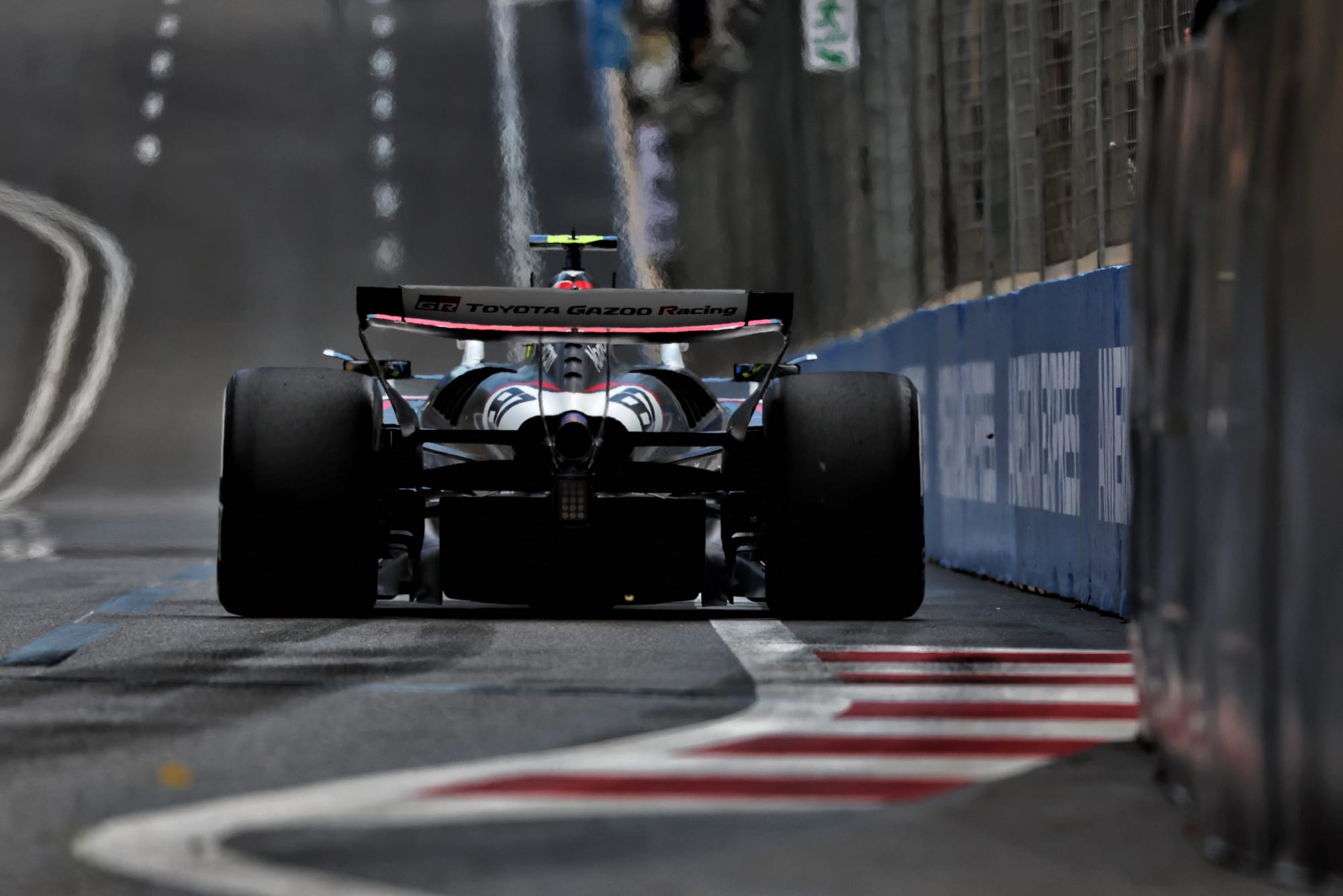
What makes a Formula 1 driver fast? The answer to this simple question is infinitely complex, but there are easily identifiable qualities marking out those who potentially have something special.
Ollie Bearman ticks one of the most meaningful boxes having proved strength in one of the many areas where Max Verstappen is F1's gold standard.
That's not to say he's as good as Verstappen, either overall or in this one area, but Bearman is closer than most to the four-time champion at the extreme end of a very important spectrum: the ability to deal with a high level of rear-end instability. This allows him to handle a strong front-end and carry the speed into the corners in a way that many others, including Haas team-mate Esteban Ocon, often can't.
"That's a fair assessment," says Bearman when The Race raises his ability to handle an unstable rear end. "I tend to like a more positive car, one that is more reactive on the front end. Generally, I can extract more laptime with a car that's behaving like that, so that's been a positive for me.
"There have been times when the car has been a bit too much on the limit and I've had to take a step back in terms of how I set it up, because I find this car [the Haas VF-25], particularly as we've put performance on, has become quite sensitive to wind and a bit inconsistent in variable conditions. So on the one side it's very positive, on the other I'm not fully able to utilise it because we find the car to be quite reactive to traffic. When it works, the car is very quick, but it's always a bit on a knife-edge."
He later adds: "Often my engineers look at the data and are surprised at how much instability I can get away with at the rear. But that's the way you have to drive these cars and that's how you get performance out of them. The key is being adaptable, and that's how I drive with this car and these tyres, that's how it likes it."
As Bearman says, there are limits to this. Car dynamics are always in the eye of the beholder; one driver's good balance can be another's excessive oversteer and even Verstappen has a point where the rear is beyond his capacity to control. But as Haas team principal Ayao Komatsu says, if you can handle that kind of instability it allows you to be enormously fast over one lap.
"If the car's 100% stable, you cannot turn - only go straight," Komatsu tells The Race. "So to be able to turn the car, you have to make it less stable. Then it's just a sliding scale of degree.
"That's why Max is so amazing, he can drive the car which has got, let's say, the least amount of stability, but he can be incredibly accurate in any conditions, any circuit, any tyres. It's incredible. Ollie is definitely more towards that direction compared to people like Esteban and Nico [Hulkenberg]. Because he's able to handle that ultimate one-lap performance, he's incredible.
"Clearly, Ollie can tolerate less stability than many other drivers. I can imagine Max is the same, but in a very extreme sense. I never worked with Max, I don't know where he is on this, but I can imagine he's very, very extreme."
Don't take this as a criticism of Ocon, who Komatsu speaks highly of. "As long as they have both got the balance right, there's not much difference at all, it's very similar," he says of their relative race pace. It's also important to note that Bearman's average qualifying advantage across 2025 was 0.140s. However, this ability to handle a car that's on the edge thanks to its instability is valuable, with Komatsu pointing out this is fundamental to Bearman's capacity to "drive around the problem".
Why braking is affected
Bearman and Ocon's differing tolerance for rear instability manifested itself in another revealing way in 2025.
The obvious expression of instability is the rear of the car moving around when a driver is rotating it through the corner, but it comes into play much earlier in the process. Stability, or ability to deal with less of it, is fundamental in the braking phase.
Towards the end of the year, Ocon talked increasingly about a supposed brake problem that held him back for several races, claiming there were occasions when he had to brake tens of metres earlier than he ideally would because attempting to match Bearman's braking point resulted in lock-ups.
This was not a technical problem related to the system or parts, but all about technique. Ocon struggled in corners requiring the confidence to brake with very high pressure at high speed, whereas Bearman brakes late and very hard. Komatsu says this makes the most of when the car's "still got loads of downforce to slow down". This allows Bearman to come off the brake sooner to be able to turn the car. By contrast, Ocon's brake trace was, according to Komatsu, a "stark difference".
Picture the two data lines like this: Bearman's has a sharp initial peak and a rapid tail-off, whereas Ocon's begins earlier, doesn't go as high, but holds its shape for longer. So by mid-corner, for example, the brake pressure might match Bearman's, but the vehicle dynamics at play are extremely different.
"If, because you haven't braked harder initially, you cannot release the brakes," Komatsu explains, "at some point you have got to turn into the corner, you're still braking and still using the longitudinal [capacity] then trying to turn the car - of course you are going to lock up.
"You've only got certain tyre capacity to use. Ollie is using all the longitudinal capacity to start off with so he can brake late, he can slow the car down, then he can come off the brake and turn. Esteban, at that initial phase, is not slowing the car down as quickly as possible. But that's his feeling stopping that.
"He's not able to brake as hard. But Ollie does brake very hard."
The learning curve
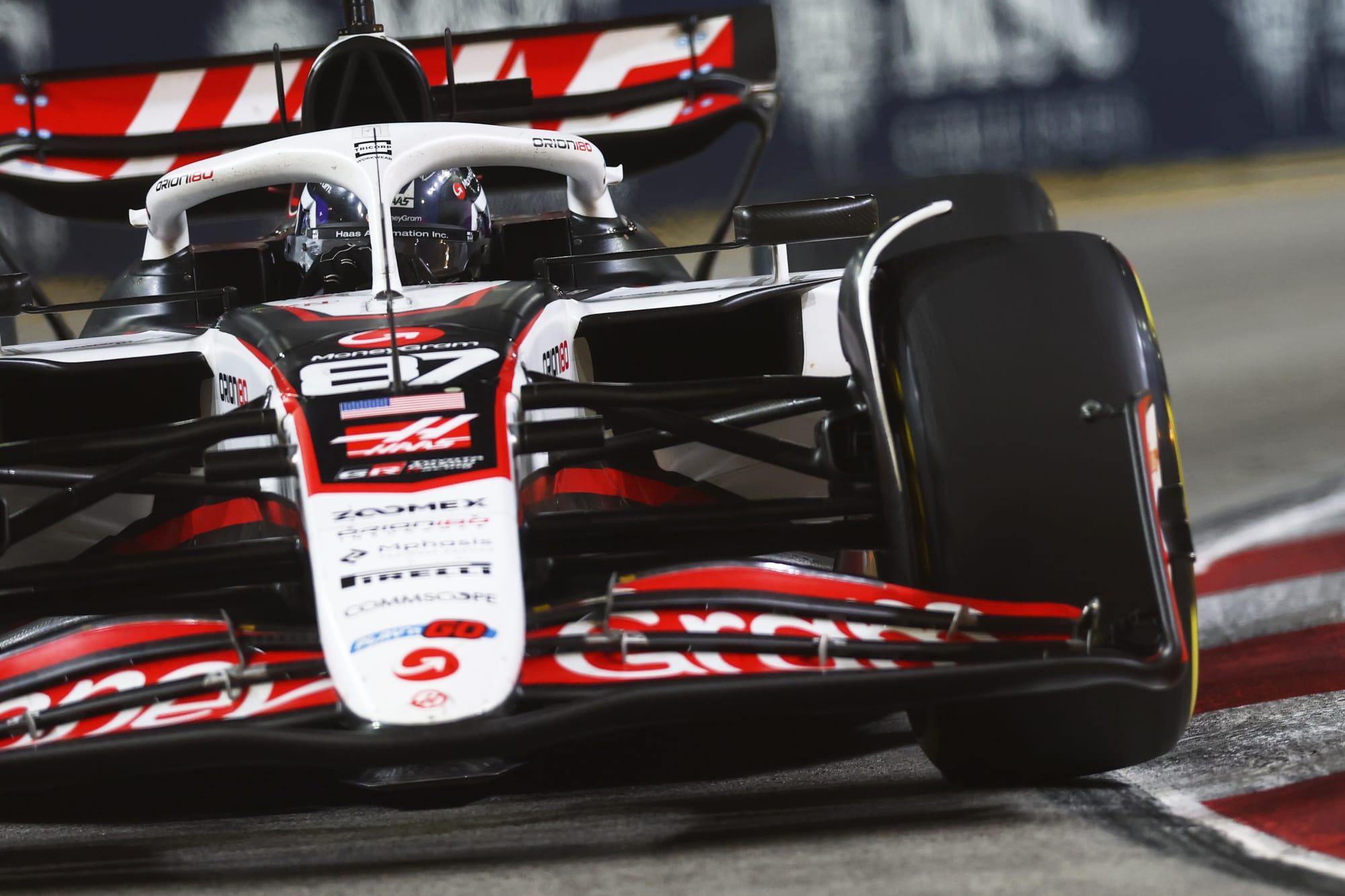
Bearman's first full season in F1 stood out because of the rate of improvement. In the first half of the season, he had the speed but too often that didn't turn into performance when it counted or needless mistakes derailed his weekend.
There are multiple examples. In Australia, he crashed in FP1 and missed FP2, then binned it again early in FP3. Komatsu, who stressed the need to gather data given the problems Haas was battling that weekend, describes this as "completely unacceptable". Red flag infringements in Monaco and at Silverstone, the latter when he crashed in the pit entry, were also costly.
Komatsu cites "mindset" as a big part of this, as in the situations in Hungary, where Bearman was fast immediately but damaged the floor three times and was on the back foot in qualifying, as other examples.
Bearman wasn't solely responsible for the missing points in the first half of the campaign (Imola, where he was rapid but undone by the misfortune of red-flag timing in qualifying then a pitstop blunder is an example of that) but his errors were undermining his and Haas's season.
That's to be expected for a rookie, but Bearman took a huge step in the second half of the year. In the 14 events prior to the August break, he scored points four times, including in the Spa sprint; in the 10 that followed, he did so six times and bagged his best result of fourth in Mexico.
That's a remarkable improvement because it's one thing to identify the problems, and Bearman was very well aware of where he needed to improve, but another to remove them. Bearman talks of his evolving approach and understanding eloquently, putting that step within the context of experiencing, understanding and assimilating lessons that many rookies either never learn, or take far longer to internalise. Translating that into improved results on track is not easy.
"You go from Formula 2, where on lap two or three of free practice you need to put the car on the limit because the tyres are degrading very quickly and you only get one set, and then you have to be ready for quali," says Bearman. "So that is one mindset, and that's the same mindset that you have to take in F3 and even to some extent in F4. Through your car racing career, by lap two or three on the track, you need to have full confidence and put the car fully on the limit. But in F1 that's generally not the case.
"Aside from the six sprint weekends, you have Friday as purely a day to set up the car and prepare for Saturday, so there's no need to take any risk beyond finding the limitations, trying things on mechanical set-up and ride heights and stuff and seeing if they work. And Saturday is really the day to start building up and really get into the rhythm of things. The risk comes in qualifying.
"Probably the first quarter, or even the first half of the season, I was not adapting my approach to Formula 1. Suddenly you have more laps and tyres than you've ever had before and you need to adapt accordingly.
"I feel like I've made that adaptation pretty well, but it hasn't been overnight. That's the way I've built myself as a driver and that's how I've been able to be competitive in Formula 3 and Formula 2. So to get rid of that is not overnight and it takes time, and that's something that in the second half of the season I've really been focusing on, and clearly it's paid dividends."
Komatsu and the Haas team's influence on Bearman in this process is very obvious. As a former race engineer, one who not only understands drivers deeply but how they interact with the car, Komatsu has very strong and logical opinions on the approach a driver takes and isn't afraid to voice them. As he puts it, "I don't mind him crashing in Q3 because that's when you have to put everything on the line, but it's a matter of mindset, approach, judgement to peak at the right point and he's doing that now".
You cannot predict when a driver might plateau in terms of this capacity to learn, hit that ceiling of potential where they either cannot or will not progress further. But if Bearman is able to continue to make such gains then he is only going to get better.
The next step
Bearman is enormously ambitious, and while he effortlessly dead-bats any questions about a potential Ferrari future his ambition will be to graduate to a full-time race seat there.
He's been on its books since 2021 and did a stellar job as emergency stand-in for Carlos Sainz by finishing seventh in the Saudi Arabian Grand Prix two years ago. The only way he will get a permanent promotion whenever Ferrari next has a vacancy is if he continues to progress along the steep learning curve.
The peak speed of drivers is usually revealed very early on. What defines how successful they are is their ability to access that peak consistently and across a wide range of conditions and car behaviour. The all-new cars in 2026 will test Bearman's adaptability; he could face a resurgent Ocon, who can be extremely effective when he's at one with the car, and knows full well he needs to be closer to his ceiling more frequently.
"I've shown my pace and I've shown how fast I can be in qualifying and races and I don't think that [level] necessarily gets higher," says Bearman. "But the extra experience is going to help me to be closer to that ceiling more often.
"I don't expect to be there every weekend because confidence in the car is the number-one factor that determines that, but also I know what I need from the car, and what the car needs from me to put it in that 98th or 99th percentile, to give me the confidence to do that.
"So those factors combined are going to allow me to use my talent and maximise my talent more often. I don't think I'm going to become a faster driver. I showed that I have great quali pace when I have a good feeling, and I can have good race pace as well. The goal is to do that more often, and I have no doubt that the trajectory will continue as it is."
Speed is one thing for an F1 driver. Bearman has shown he has the blend of physiological and mental qualities needed to live with a car on a rapid knife-edge, meaning this phase of his career is all about being moulded into the best-possible version of himself. Doing so guarantees he will at least be a very good F1 driver, and the potential is there to be even more than that. It was that dash of magic that so impressed Komatsu when Bearman first drove a Haas in FP1 at the 2023 Mexican GP.
"His speed was so clear from the beginning, so it's more about delivering that level consistently," says Komatsu. "That's why we've been talking about mindset, that's why I've been talking about putting in performance throughout the weekend, and building it up.
"Let's say, for argument’s sake, if you're building up like this for now, the next step might be he can still build it up without any mistakes but from a higher level. That's the margin [for gain] I still see, but this is to take away nothing from what he's achieving. The next level would be [start] one or two steps higher and still build it up. And then make no mistakes."
Listening to Bearman talk through his craft behind the wheel proves beyond any doubt that he's a driver with a high ceiling and the right mentality to get somewhere close to it over the coming years. There's none of the tell-tale mismatch between what he says and Komatsu's appraisal, indicating that amid the inevitable confidence and certainty that underpins any F1 driver, he's also capable of self-criticism.
Nothing is certain in F1, and the 'difficult second season' could pose unexpected challenges. But if he can maintain his steep trajectory, expect talk of a Ferrari promotion to get louder.
from The Race https://ift.tt/SKl5Whf


No comments: