
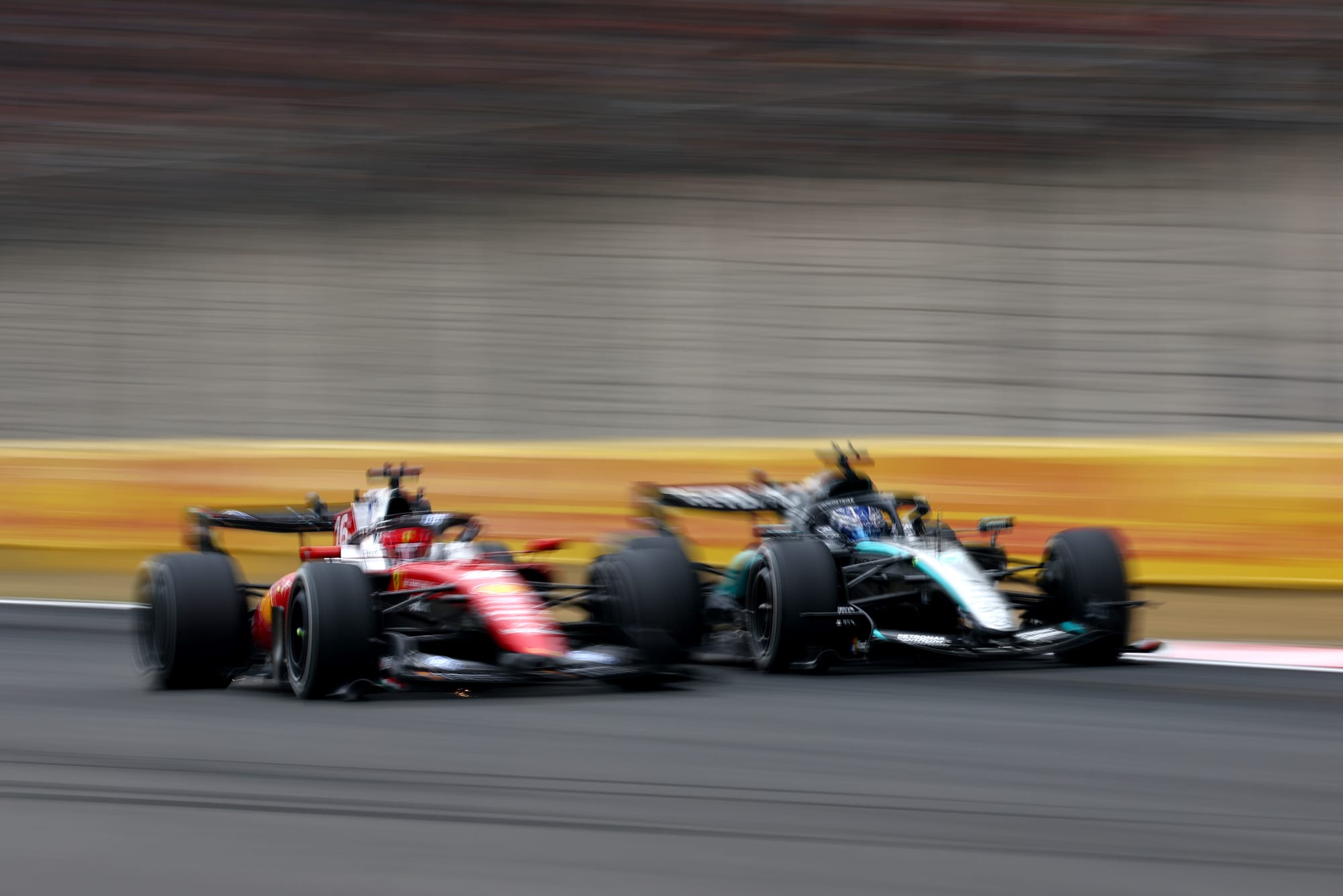
In the polarised debates about Formula 1 2026's racing style, there's a point which those bemoaning its artificiality probably need to accept: no matter what tweaks to the technical regulations that are made later this season or into 2027, F1 is not about to willingly surrender the dramatic wheel-to-wheel dices the new rules have facilitated.
It's just too spectacular, too viscerally exciting, too appealing to new fans for F1's commercial powers to give up. No matter how strongly hardcore fans feel that it's too artificial.
F1 will for sure try to address concerns about energy deployment variations, making overtakes ridiculously easy, as at Melbourne's Turn 9, when the sudden loss of 470bhp by the lead car towards the end of the straight allowed the following car, still with battery deployment, to sail by with no particular skill required of the driver.
The overtaking at Shanghai - a much less energy-starved circuit - was somewhat different in nature to that. Dicing cars were arriving at the braking zone for Turn 14 - the prime overtaking spot - with equally depleted batteries and the moves were conventional outbraking ones.
Similarly, they'd then each harvest enough energy by braking for Turns 14 and 15 that they'd comfortably have enough battery to fight out Turns 1/2/3 in a conventional way.
The boost function was still allowing the Mercedes/Ferrari dice (and the Lewis Hamilton-Charles Leclerc dice within Ferrari) to last for many laps by giving the car behind the extra energy to stay in touch. But the actual overtakes were, in the main, down to the drivers.
The way the circuit layout worked meant that any momentary 470bhp mismatches came far too early on that long back straight to guarantee an overtake into the corner. Trying to replicate this at all circuits to give the great entertainment without the meritless battery pass is going to be difficult, but that's for sure where F1 will be looking.
But it absolutely will not be attempting to recreate the old format of racing now that it's tasted the honey of TV-friendly racing action it's long only dreamed of. F1 hasn't seen this sort of extended wheel-to-wheel action since the pre-chicane Monza slipstreaming days over half-a-century ago.
However, it might ponder that the Mercedes/Ferrari lead battles are not only predicated upon the new energy split/boost button/active aero regulations. There's another crucial factor: the diametrically opposed traits of the two cars, with a Ferrari that is faster off the line to make the Mercedes qualifying advantage positionally worthless, but a Mercedes which is powerful enough to eventually grind its way by the Ferrari after many laps of boost-assisted dicing. We didn't, after all, see quite the same long-running wheel-to-wheel exchanges further down the field.
If the expected performance-equalising Additional Design and Upgrade Opportunities mechanism is used to peg the Mercedes power unit back after six races, as widely expected, might the delicate balance of qualities between the two cars be broken?
If it really wishes to sustain this spectacular pattern of racing, F1 needs to be careful not only in how it tweaks the energy splits, but also in how it applies the ADUO.
"Let's see what kind of political knives are going to come out in the next few weeks and months," says Mercedes' Toto Wolff before going on to praise the racing action.
"What we've seen is good racing. With many overtakes. We were all part of F1 where there was no overtake, literally. Sometimes we are too nostalgic about the old years, but I think the product is good."
Obviously, Wolff will be protective of his team's advantage in how he's framing his argument. But that doesn't make the argument wrong.
from The Race https://ift.tt/z4QRiUC


No comments: