
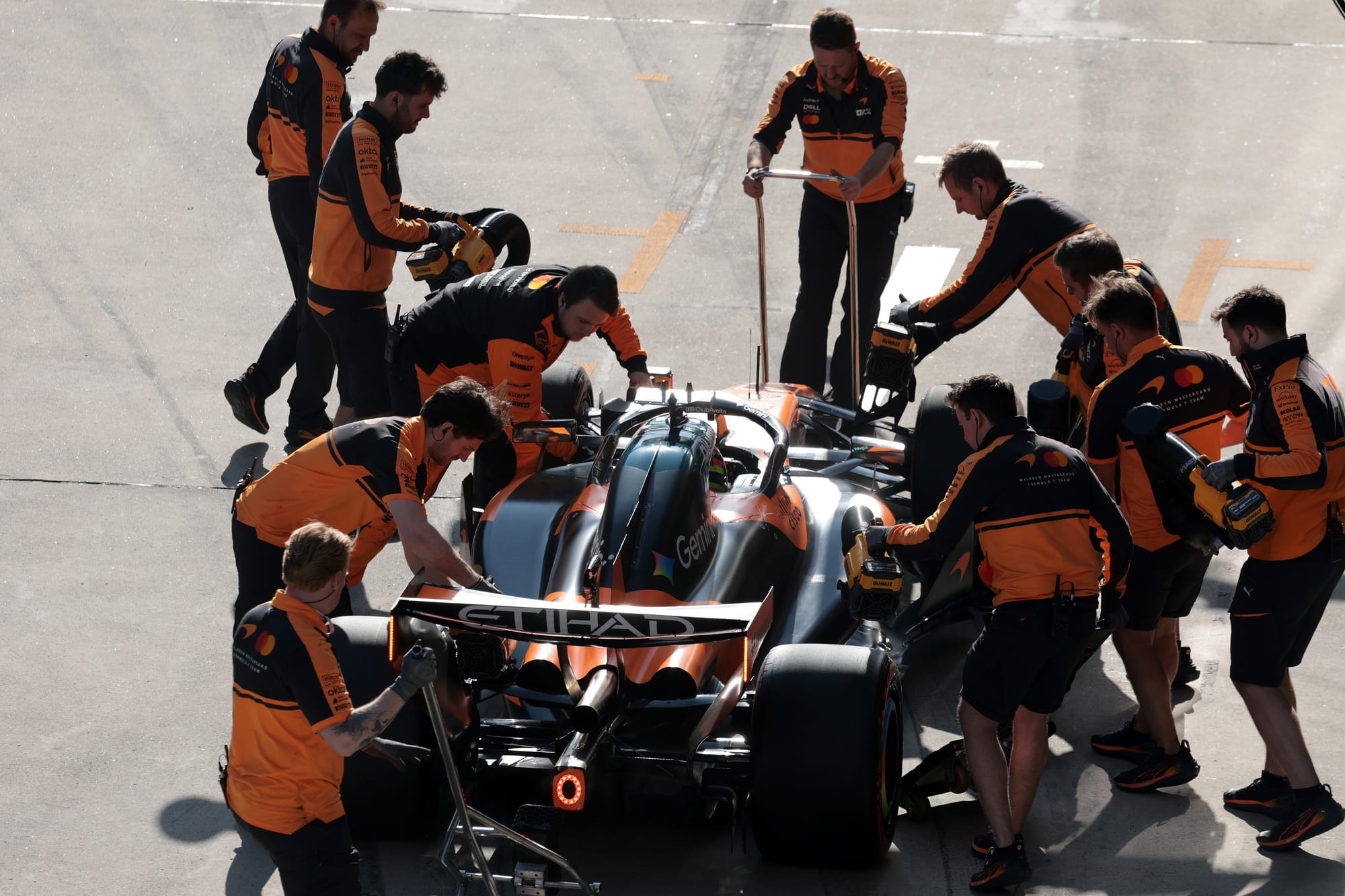
McLaren's Formula 1 title defence has started miserably, but it's facing bigger problems than simply the embarrassment of having to withdraw both its cars before the start of the Chinese Grand Prix.
It appears that galling double did-not-start was down to two different failures on the same component of its customer Mercedes power unit.
"This is an area of the car which is not under McLaren's control, so we rely entirely on what is reported by HPP [Mercedes High Performance Powertrains] and we trust completely their report," McLaren team principal Andrea Stella said.
The root cause is yet to be identified but, whatever was ultimately behind it, McLaren is already 80 points adrift of the championship leader Mercedes with just 18 points from two grands prix and a sprint race.
Points-wise, that's the worst start to a title defence in over a decade, only comparable to Red Bull's in 2014, which is skewed by Daniel Ricciardo's disqualification from second place in Melbourne for fuel-flow irregularities.
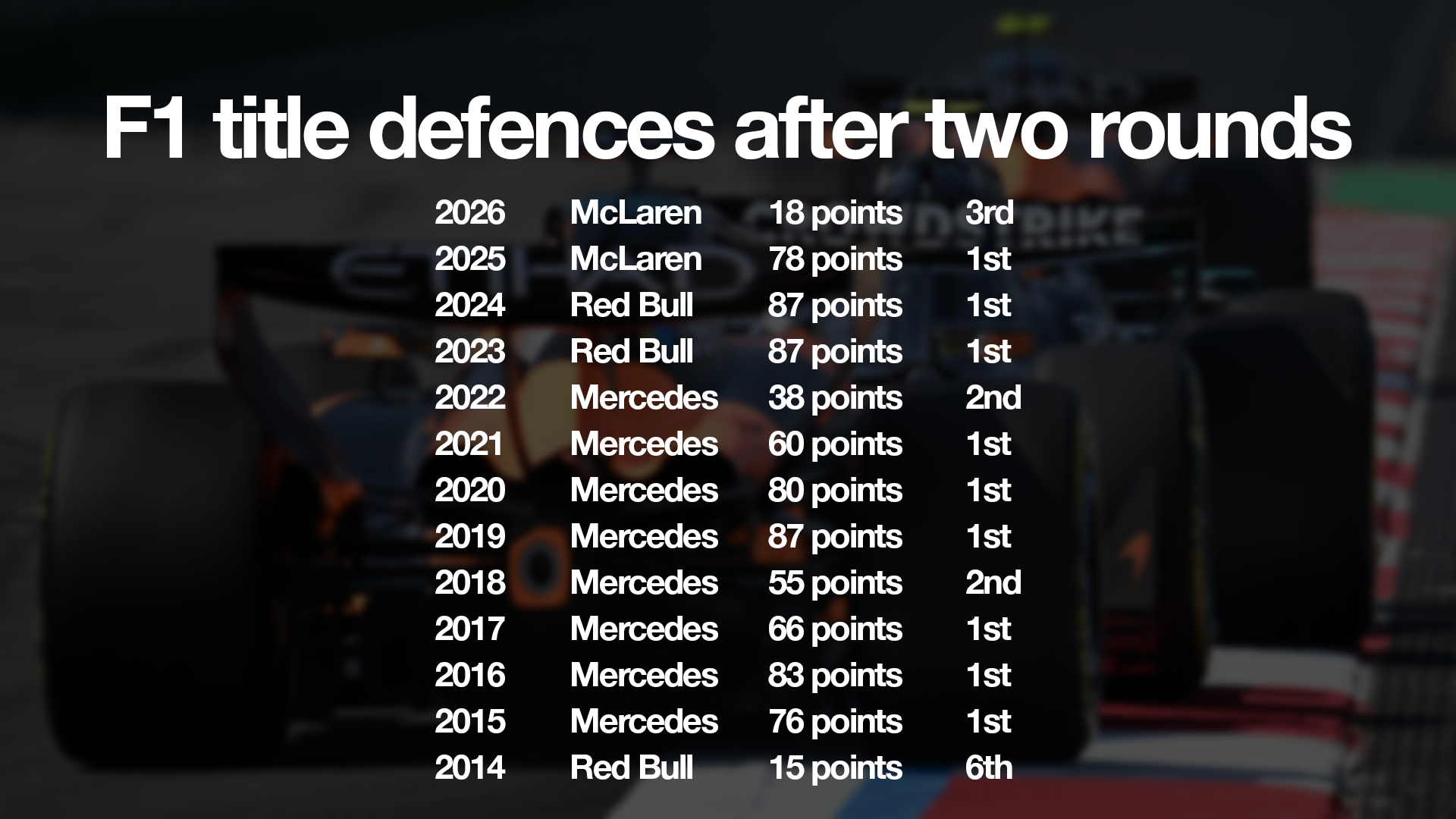
And McLaren has benefited from having a sprint race that didn't exist in 2014 and which accounts for a third of its 2026 points.
Take away the six points McLaren gained there, and it's easily the worst start for a defending champion since Ferrari's nightmare point-less start to 2009 that lasted three rounds.
It's not just points McLaren is lacking, but real performance to Mercedes despite having the same engine, and right now it's not even making the best of the car it does have.
On-track data is more valuable than ever in 2026 with the complex power units, and McLaren is currently way behind Mercedes and even has fewer racing laps completed than the vibrating Aston Martin-Hondas!
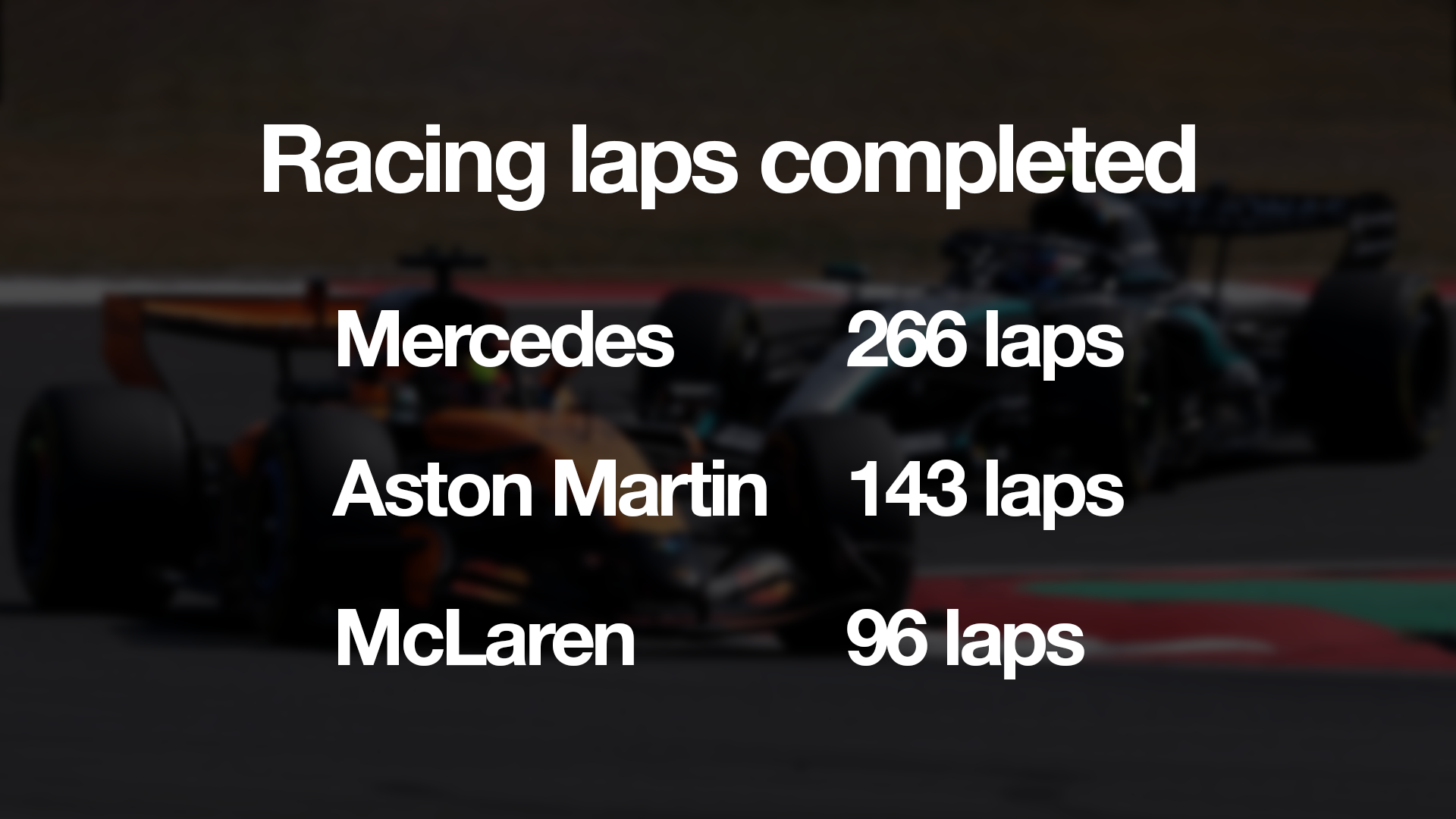
Yes, McLaren has way more actual on-track data because it's completed tonnes more laps through testing and practice, but to be less reliable than Aston Martin in races isn't great.
Reliability issues limited world champion Lando Norris in Melbourne practice, but the main reliability letdown was the usually dependable Oscar Piastri crashing before the race started, having been caught out by a strange torque increase on his reconnaissance lap.
Then Shanghai exposed how vulnerable this McLaren is, even if it's "quite exceptional and uncharacteristic that you have two terminal problems pretty much at the same time, on the same component", in the words of Stella.
The works Mercedes team hasn't been without its own reliability issues; it lost track time throughout testing to them, but it's largely avoided them when it counts.
George Russell almost couldn't take part in Q3 in China, but Mercedes has yet to lose big chunks of points to them as McLaren has. Nor has fellow (brand-new) Mercedes customer Alpine.
Williams certainly has had a fistful of reliability problems, but they're more mixed in with its own car problems, so it remains to be seen whether the early McLaren reliability woes are an early trademark of this McLaren package or an unfortunate high frequency by coincidence versus the works team.
McLaren cited the points lost in the championship as the biggest disappointment of the double DNS because while McLaren's car is nowhere near a match for the Mercedes right now, it wants to keep itself in the hunt points-wise in case that changes later in the season.
Don't forget 2024, when McLaren didn't start the year with the fastest car, but banked a healthy number of points before an upgrade package at round six in Miami turned its car into one capable of overhauling Red Bull for the constructors' title.
It hopes to repeat its big development wins of 2023 and 2024, a period in which it transformed itself from a midfield straggler to world champion in 18 months.
But that's not necessarily going to be as easy to repeat in 2026.
A rude awakening
The opening two races of 2026 have been a rude awakening for McLaren on two fronts.
First, there was the reality check of Melbourne qualifying, where the works Mercedes team showcased how it's optimised its engine in ways McLaren couldn't yet understand.
Mercedes and its customers have identical power units as per the rules, but Melbourne exposed a big knowledge gap between engine supplier and customers in how to get the best out of these 2026 power units.
What Mercedes was able to do "puzzled" McLaren, which was over eight tenths slower than Mercedes in qualifying and over 50 seconds behind in the grand prix.
McLaren has worked hard to close that power unit knowledge gap, and it did edge closer to the overall pace in Shanghai as a result, even if we couldn't see what it could do over a race distance.
It was six tenths off in sprint qualifying on Friday and then within half a second in grand prix qualifying on Saturday.
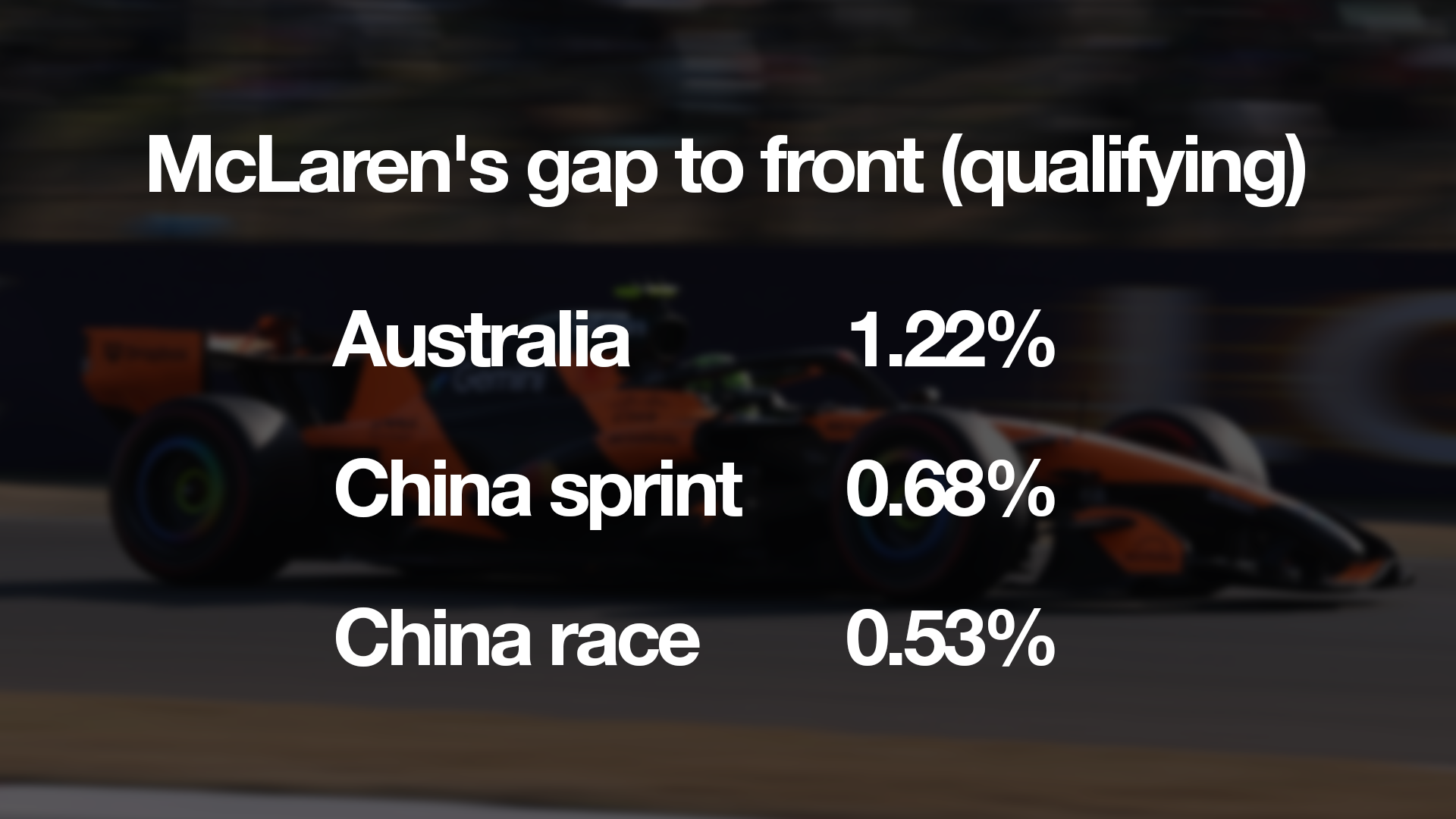
So McLaren is potentially chipping away at some of that Mercedes advantage, although that was consistent with most rivals in China versus Melbourne with a more compact field.
McLaren is learning "quite rapidly", according to Stella, and has closed in on some of the power unit exploitation advantage held by Mercedes, but it still believes there's further engine exploitation gains to be made in the coming races.
As Piastri explained, McLaren "leaves every qualifying session feeling like we've done a good job of maximising the power unit and then we get back and find there's a chunk of time that we didn't realise".
McLaren has made it clear it's "not complaining" about Mercedes either. It accepts that the works team has a small advantage when it comes to making bigger, immediate gains because it's one single entity.
After Melbourne, McLaren believed roughly 50% of its deficit was down to inferior knowledge of how to exploit its Mercedes power unit compared to the works team.
Stella thinks the team is exploiting the power unit better than it was, so the main deficit is now McLaren's chassis and the grip it gives it in the corners.
This was the second wake-up call for McLaren; now the power unit knowledge gap has been partially closed, it's lacking aerodynamic efficiency and downforce versus Mercedes.
An 'underdeveloped' car
Norris believes the McLaren is not a car capable of fighting for a podium right now, let alone a win, a situation the team hasn't experienced since 2023.
Comparisons have inevitably been made to the early part of that season, but the situation McLaren faces is very different now.
"There's a fundamental difference to 2023," Stella said.
"This car that we have at the moment is a solid platform. If anything it is slightly underdeveloped, let me say, like there's nothing in the car that is not sound conceptually, it just needs to be developed further, but following kind of the conceptual lines that we have outlined in the launch phase of this car.
"In 2023, we needed to rectify some designs, pursue some different aerodynamic concepts, because the concept that we had in 2022 and into 2023 would have not taken us very far. So we needed to sort of go back to the drawing board, redesign more conceptually what aerodynamic flow field we want to achieve and then review the geometries quite extensively.
"Instead, the journey for this car will be more about accelerating the development along principles that we think are sound, if anything [is] still a little too below the line of development of where Ferrari and Mercedes seem to be at the moment."
There's also an element of its underdeveloped car compromising its power unit exploitation right now, too.
McLaren's downforce shortfall versus Mercedes has negative consequences for the amount of energy it can harvest, particularly when lacking grip at the rear through corners.
The Mercedes being more planted through the corners means it can harvest more efficiently than the McLaren, which is scrambling longer for grip.
One factor in the downforce shortage could be the shorter wheelbase car McLaren has opted for in 2026.
That helps it move ballast around for a wider balance window, but means it has a lesser floor area, so less downforce.
There is a potential weight advantage with a shorter car, but rivals like Mercedes have, perhaps to McLaren's surprise, managed to offset that.
It might make McLaren a decent contender in Monaco, along with Ferrari with its smaller turbo, but it's currently limited to third-best in the pecking order.
Can it close the gap?
Stella expects the McLaren to be "significantly improved in the coming races", with big upgrades targeted for round four in Miami at the start of May.
Norris felt the new, extended five-week gap between races leading up to Miami, because of the cancelled Bahrain and Saudi Arabian rounds, is a good thing for McLaren as it gives it more time to work out how to catch up.
"We can fight for podiums at some point this year, and we can fight for wins later in the season,” Norris said, even if he accepted it has been a "tough start".
McLaren is trying to "develop the car as fast as possible in every single area", according to Stella, but its problem is that every team on the grid.
It's why, despite the circumstances being different, Stella hopes to replicate 2023 and outdevelop its rivals.
McLaren's aero department proved itself to be the class of the field in the second half of F1's ground effect era, even showing up the Mercedes works team.
But while it's the same personnel, there's no guarantee it will be able to replicate its success from the previous generation. You only need to look at how Mercedes went from world champion to third- or fourth- best most of the time in the last era.
McLaren has "taken inspiration" from other cars, too, which it's merging into its existing development plans.
It means the Japanese GP at the end of March will be more of a test just of whether the team can bank the kind of points it couldn't in China.
The real test for McLaren will then come in Miami after it's had that extra time to work things out.
Then we'll find out whether it's still the market leader when it comes to in-season development, or whether its title defence bid will be facing a terminal blow.
from The Race https://ift.tt/dPZeL8r


No comments: