
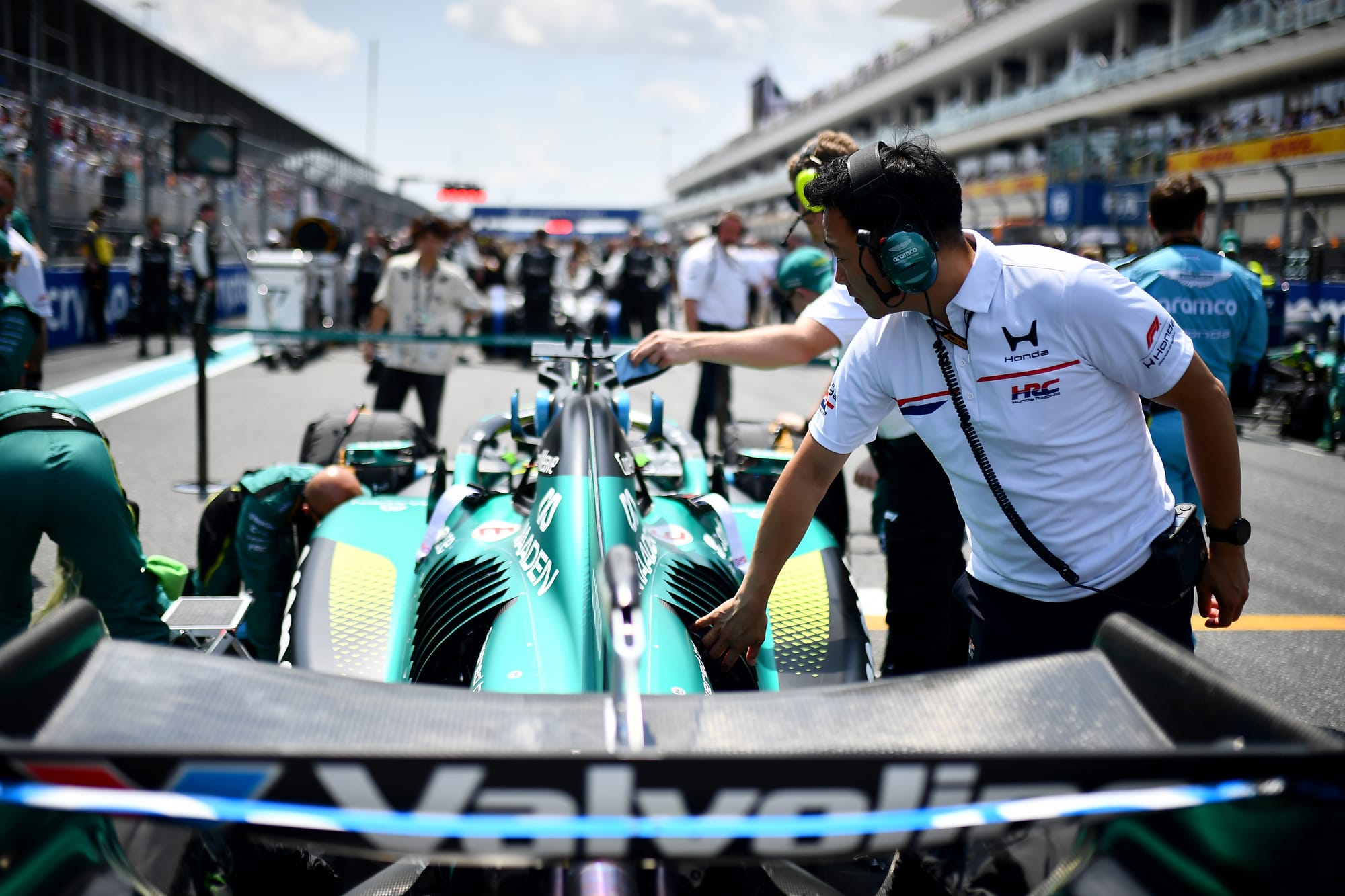
The potential for Honda to have a $19million spending boost to help its engine recovery in Formula 1 appears, on the face of it, to be quite generous.
After all, with power unit manufacturers operating under a cost cap, such extra funding is enough to not only get Honda back in the mix but also give it the momentum needed for a push to the front over the next few years.
Let's not forget that Honda went from a disastrous modern era return with McLaren from 2015 to 2017 to powering Max Verstappen's first drivers' title win with Red Bull in 2021.
But don't think for a second that Honda's rivals have ignored history and agreed, for the good of F1, to give the Japanese manufacturer a blank chequebook so it can become dominant.
Instead, there are complications and compromises laid down for Honda to get some of the extra cash - plus it will involve some big strategic calls that will impact long-term fortunes.
Honda's helping hand
The changes agreed to help Honda come as part of F1's regulations related to Additional Development and Upgrade Opportunities (ADUO).
This catch-up mechanism was integrated into the 2026 rules to help any manufacturer with a new power unit that was well adrift of the benchmark.
Any manufacturer deemed to be 2% adrift after a defined segment of the 2026 campaign would be allowed an additional engine upgrade for this season and one for the next one.
If any marque was 4% adrift or more, then it would get two development chances this year and two in 2027.
To help make the upgrades for new specification engines, those manufacturers deemed to be qualifying for additional development also get more testing hours and more money.
In terms of test-bench running, manufacturers 2-4% behind get an extra 70 hours, those 4-6% behind get 110 hours, 6-8% behind gets 150 hours and there had been a previous cap of 190 hours for anyone more than 8% off.
That cap has now been lifted, meaning that any manufacturer that is more than 10% off, as Honda appears to be, gets 230 hours extra.
Extra money
There is a similar sliding scale on cost cap spending too, with two elements making up the potential for Honda to get the total of $19m extra spending.
The first $11m relates to adjustments allowed in the cost cap, which means more spending power for any manufacturer that is granted upgrade concessions.
Previously, the extra cash on hand had been a $3m boost for manufacturers who were deemed to be 2-4% adrift over the season.
It then went all the way up to $8m for manufacturers that were deemed to be behind by more than 8%.
Now what has been agreed is that any manufacturer over 10% off will get an extra $11m.
But there is now also a second element of the cash boost that is a lot more interesting, as it is not a simple hand out.
Instead, it is a type of loan - and Honda is going to have to borrow money off itself from the future.
Borrowing against the future
Worth a maximum of $8m, revised rules allow for a performance-based loan-style system for any manufacturer that is deemed to be behind by more than 10% in its first season.
This available extra spending "on paper" is classified as relief rather than a gift, so has to be paid back.
That is done through reducing the declared cost cap expenditure over the two seasons it is claimed - but it then gets added on to future years beyond that.
In simple terms, spend an extra $8m in 2026 and 2027, and you need to pull back your spending by $8m over the following three years as a consequence.
In theory you are front-loading extra development spending, rather than holding it back for future years when cost cap limits have reset.
How it gets paid back
The rules allow a manufacturer granted this relief the choice of how much extra they want to spend and how it gets split across this season and next.
It must then repay 100% of whatever relief is taken - although there is a degree of freedom in how that repayment is split.
The repayment is spread over the three seasons after it has been spent, but each of those three years must have at least one payment that is somewhere between 20% and 50% of the total amount.
The flexibility of how much a manufacturer chooses to take, and how it then decides to pay it back, means there are many options in terms of how aggressive it wants to be.
It could choose to be balanced and split both the $4m and the payback over the maximum duration.
Here is one example - with N being the current season:
Downward adjustment (relief they take now)
Inaugural season: $4m (50%)
N+1 season: $4m (50%)
Upward adjustment (pay back later)
The manufacturer must spread the full $8m across N+2, N+3, and N+4, with each year getting between 20% and 50%. One possible split:
N+2: $3m (37.5%)
N+3: $2.5m (31.25%)
N+4: $2.5m (31.25%)
Or it could front load the relief and backload paying it back:
Inaugural season: $6m (75%)
N+1 season: $2m (25%)
(This gives it more cost-cap breathing room in its very first season.)
Upward adjustment (pay back later)
N+2: $2m (25%)
N+3: $4m (50%)
N+4: $2m (25%)
The rules are explicit that a manufacturer taking the extra spending freedom cannot repay the whole amount in a single year, and that no more than 50% can be paid back in a single season.
So it would not be allowed to use 60% one year and then slash that back to 10% the next.
There will be a price to pay for extra development now that will last for a considerable time - and not be worked around by some clever financial tinkering over a single season.
The choice is then clear for Honda in terms of how much it wants to invest now to make big gains, and how much it wants to hold back so it isn’t left without any development budget in the future.
It could choose to throw everything it can at the present, so it gets itself into a better position as soon as possible, but equally it may conclude that it is better to take things slow and steady and not burn through the cash immediately.
The call on that will first of all depend on how far adrift the FIA deems Honda to be when it makes its first ruling on where each manufacturer stacks up after the Canadian Grand Prix next week.
Only then will Honda know what its real options are.
from The Race https://ift.tt/1sTqcKl


No comments: