
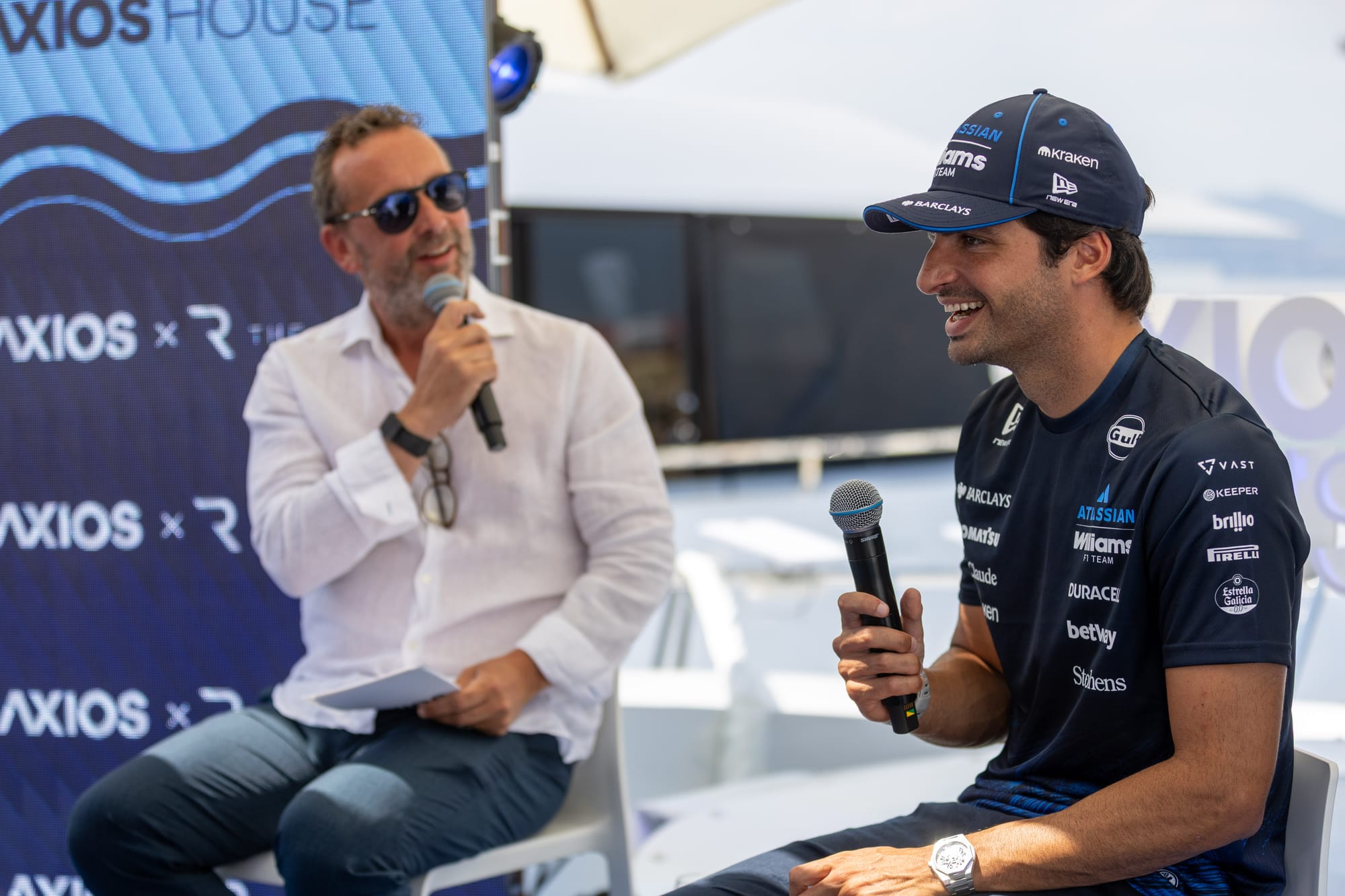
Carlos Sainz said his decision to give Netflix unprecedented access to his private life during the early days of Formula 1's Drive to Survive series proved "game-changing" for both his career and the sport's global growth.
Speaking to The Race co-founder Darren Cox at the Axios x The Race Cannes Lions panel: 'Sports, Sound and the Latino Fan' on Wednesday, the Williams star recalled being among the drivers willing to embrace the documentary project when it first arrived in the F1 paddock in 2018.
"I analysed it with my management team and I said, 'Look, this could be game-changing, so let's give Netflix access at least the first year until we see how this pans out,'" Sainz said.
Sainz admitted he had reservations about opening up his personal life to cameras, describing himself as "very private" and uncomfortable with the idea of filming around his family and contract negotiations.
Despite those concerns, Sainz allowed Netflix crews into his home in Mallorca, including filming scenes with his family. When the first season aired, he quickly realised the impact.
"I think I grew 500,000 followers in two weeks," he said.
"I was like, OK, all this time and effort that I've spent giving maybe too much of an insight for my liking to cameras, it's paying off and it's worth it."
Sainz said the success of Drive to Survive coincided with F1's wider transformation under Liberty Media and accelerated during the COVID pandemic, when many new fans discovered the series.
"I think the Netflix boom, when we started filming Netflix around 2018, then COVID happened, and I think in COVID everyone watched the Netflix series," he said.
The 31 year old described witnessing the championship's dramatic rise in the United States first hand, comparing visits to the Austin GP before and after the Netflix era.
"I lived through experiencing going to Austin and maybe not seeing that many fans, and then suddenly two years after COVID going to Austin and finding an insane amount of people there," he said.
Sainz believes the series helped drivers recognise they were no longer simply competitors but also ambassadors and public figures.
"Now I'm not only a Formula 1 driver, I also need to be careful of my brand, of the people that I partner with," he said.
Madrid 'simulation'
The Williams driver also took the opportunity to plug the upcoming Spanish Grand Prix in Madrid, which he has played a key role in helping promote at the new Madring circuit.
Rather than simply raising awareness of the event, the Madrid-born driver revealed he had personally tested one of the circuit's key selling points: its proximity to the city centre.
"I did the test for all the fans," Sainz said proudly.
Drawing a comparison with the simulator work that dominates modern F1, Sainz said he conducted his own simulation of a race weekend journey, travelling by Madrid's metro system from the city centre to the circuit to see how accessible it would be for the fans.
"In F1 we love simulations," he said. "I did a simulation and it took me eight minutes door-to-door."
The exercise was designed to demonstrate what organisers hope will become one of the race's defining features, a grand prix that can be reached by public transport in minutes rather than requiring lengthy journeys outside the city.
from The Race https://ift.tt/xMDkRz8


No comments: