
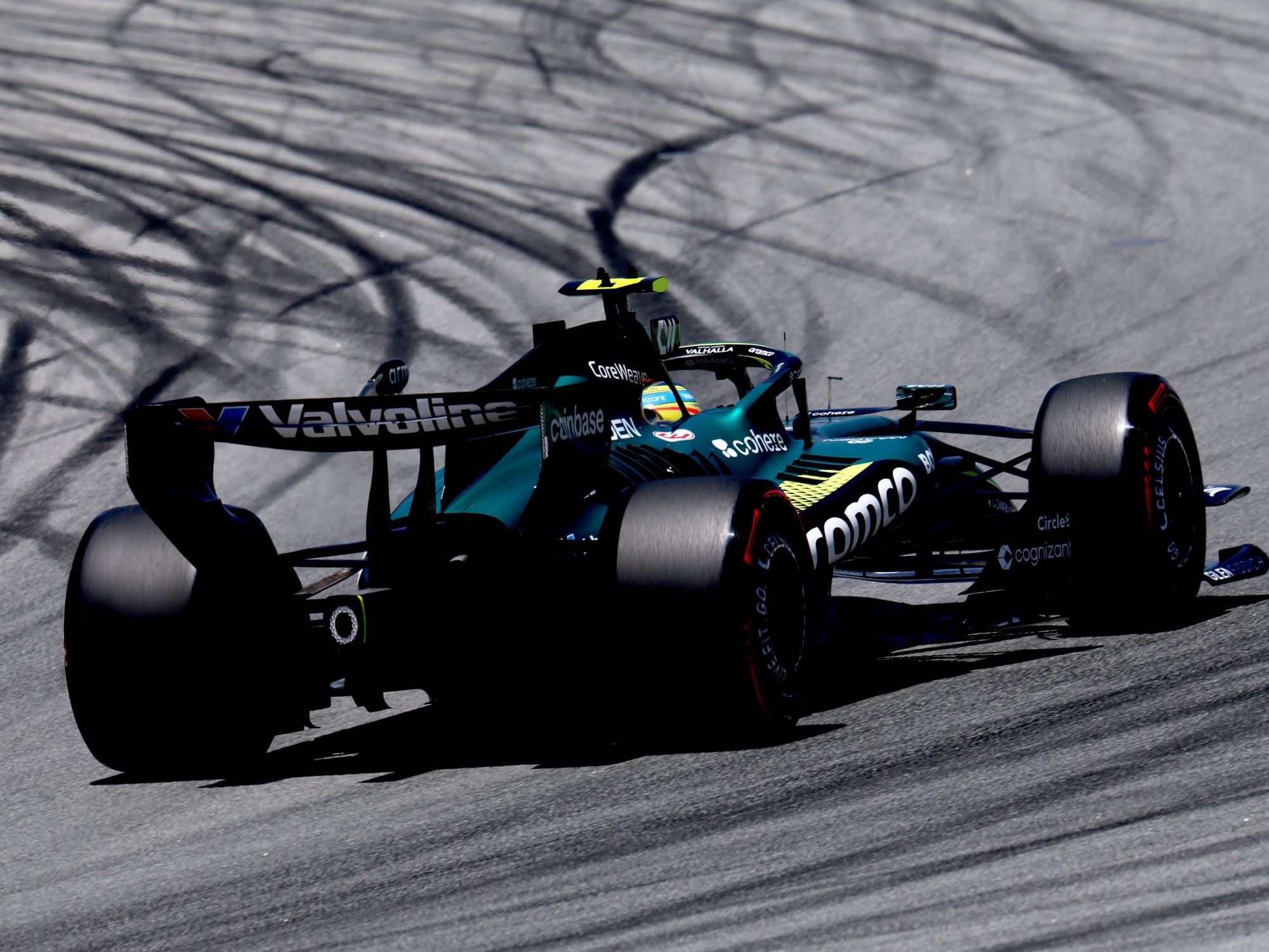
Honda's motorsport boss openly admits the gap between expectations and the reality of its performance with new Formula 1 partner Aston Martin this year was much larger than anticipated.
But scrape away at the reasons for this mismatch and there are some interesting strands to explore about why a manufacturer that produced title-winning turbo hybrid V6 engines found itself in such a difficult situation amid excessive vibrations and a lack of performance.
The reasons are complex, as there were many factors that came together to create the situation. But what has become abundantly clear as the campaign has worn on is that this was not a simple case of Honda tripping up alone.
Instead, it is more about how new rules, new relationships, new car dynamics and new processes collided with the impact of some old decisions and things that worked well in the past to catch it off guard.
As Honda Racing Corporation president Koji Watanabe told The Race in an exclusive interview detailing the challenges of the season so far: "If I talk about the engine only itself, the vibrations were almost similar to the vibrations of the 2025 [engine]....which was no problem at all."
Going from zero
One of the mysteries about the scale of Honda's difficulties in 2026 is that it proved to be one of the best at creating a turbo hybrid V6 F1 engine.
Its multiple title successes with Red Bull from 2021 through to 2024 proved that it had the expertise to understand the demands of the engine concept and its architecture.
So why, with the turbo V6 remaining a core element of the new F1 rules, did Honda struggle?
From Watanabe's perspective, a lot of the answer lies in so many things being new for Honda: new rules, new fuel supplier, a new team partner and a completely new way of working.
"The regulation was a big change, and this regulation is quite difficult," he said. "Also the team was new, and also there were big changes with the fuel and lubricant.
"So everything was new for us, and the circumstances were much different from our time with Red Bull. So it's quite challenging to go from zero with all these new partners."
There was also a much talked about element of Honda having lost valuable development time compared to rivals as the result of it having originally shut down its F1 project following an initial plan to withdraw from the championship at the end of 2021.
"I sent the engineers back to Honda Group at the end of March 2022, and we announced the return to Formula 1 in April 2023," explained Watanabe. "So in that period we almost stopped F1 activities.
"Of course we continued to provide the PU to Red Bull, but the number of engineers was quite small. As soon as we announced the return to Formula 1, then we got back engineers from the Honda group, or even hired new staff. But it took time."
Watanabe is keen to point out that the situation did not result in Honda being left with engineers who knew nothing about F1.
It was more a case of there being a period of time where the racing division was not running at full steam because key engineers had not yet returned.
"It was not easy to immediately [get them] back," he said. "Sometimes it took two months for one leader to return, or one guy needed three months. It took almost one year to get 100% of the staff."
A bolt out of the blue
While there had been rumours over the winter that Honda was not going to start F1's new rules era in the form to win races, few anticipated it would face the scale of drama it did.
In fact, Honda itself was unaware of the vibration nightmare it was heading into until a reality check hit when it matched up its new power unit with the Aston Martin chassis on the eve of the first Barcelona test.
"After we combined chassis and PU and tested on the circuit, then we recognised that it's a problem," revealed Watanabe.
"We didn't expect such a kind of big vibration. Of course before the testing we had tested on the dyno, but at the time the vibration was not so big, so there were difficulties in how to solve the problem."
The exact reason behind why a power unit that vibrated little more than it had at Red Bull suddenly became a huge problem is not clear, and Watanabe declines to go into too much detail.
"It is a mixture..so not only one single cause," he smiles without offering more insight.
But with the cure only appearing after Honda had been able to get an Aston Martin chassis on its dyno in Japan, it suggests that there was some trigger from how the power unit was interacting with the chassis.
Watanabe says solutions came from both hardware and software modifications, but he is reluctant to go into too much detail beyond being clear that the biggest handicap from the early part of the year is now gone.
"The vibration is solved, and now we are focused on the performance," he said.
The Newey factor
There was perhaps no more challenging weekend for Honda than the season-opening Australian Grand Prix.
As the realities of its competitive struggles were laid bare on track, there were also some difficult moments off it as team principal Adrian Newey did not hold back with his words in press conferences in Melbourne.
While Newey's claims about the AMR26 being the fifth best chassis and Honda's vibrations being bad enough to risk driver injury clearly put the public blame on Honda, Watanabe said that there had been no beating around the bush in private either.
"The internal discussion between Adrian and myself is quite open and honest," he said. "Of course what he said to the outside media, that has some impact, but [what is] important is how we can discuss in an honest way and open way to solve the problem.
"We continued this kind of attitude between us and Aston Martin. So that's why we could solve the problem step by step."
Watanabe suggests that what Australia perhaps exposed most was that Honda and Aston Martin had not got to know how best to work with each other - and that was something that only time would sort out.
"Of course, the relationship was not immediately established," he said. "It needed time, it needed experience.
"Step by step, our relationship between Honda and Aston Martin team is getting stronger day by day. I'm quite satisfied. But it took time. How to work is different from our previous partner."
The next steps and a moving target
With the vibration problems now sorted, Honda's focus is on delivering more performance from its engine.
It has openly talked of gains to be had from improved combustion and the reduction of internal friction – with ADUO deemed as a "quite important" tool in its ability to help introduce an upgraded power unit that is provisionally slotted in for around the time of the Belgian GP next month.
Speaking about what is to come, Watanabe said: "It's not easy, but we are improving the combustion, to improve the performance of the ICE.
"In this season we want to be in a position to compete for points, and then the key for the start of next season is how we can improve the situation.
"Of course it depends on competitors also, so it's not easy, but we try our best."
Looking to the future, one interesting side story is that Honda was the only manufacturer to not vote in favour of the rule changes that are coming for 2027 and 2028.
Watanabe is eager to point out, however, that not being supportive was not because it did not back the idea of the rule changes – it was more about the timing of it and how that impacted Honda's ability to close down on others.
"That's a misunderstanding," he said about Honda rejecting the rule changes. "So of course I joined the FIA meetings, and I always said that I respect and understand the concept [of the change] itself, and I agree. But the timing of the step is just a discussion point.
"The first step [for 2027] is very small, it's not difficult. But a moving target is sometimes not easy for the follower if we need to catch up. But we can solve the problem."
Despite Honda's difficult start to life with Aston Martin, and challenges caused by ever changing regulations, it is certainly far from believing it cannot repeat history and go from back to the front of the grid as it did with Red Bull.
"Yeah, why not?" smiled Watanabe: "It's not easy. But I believe that we have potential to return to the position to compete at the top level."
from The Race https://ift.tt/tKG2ZP1


No comments: