
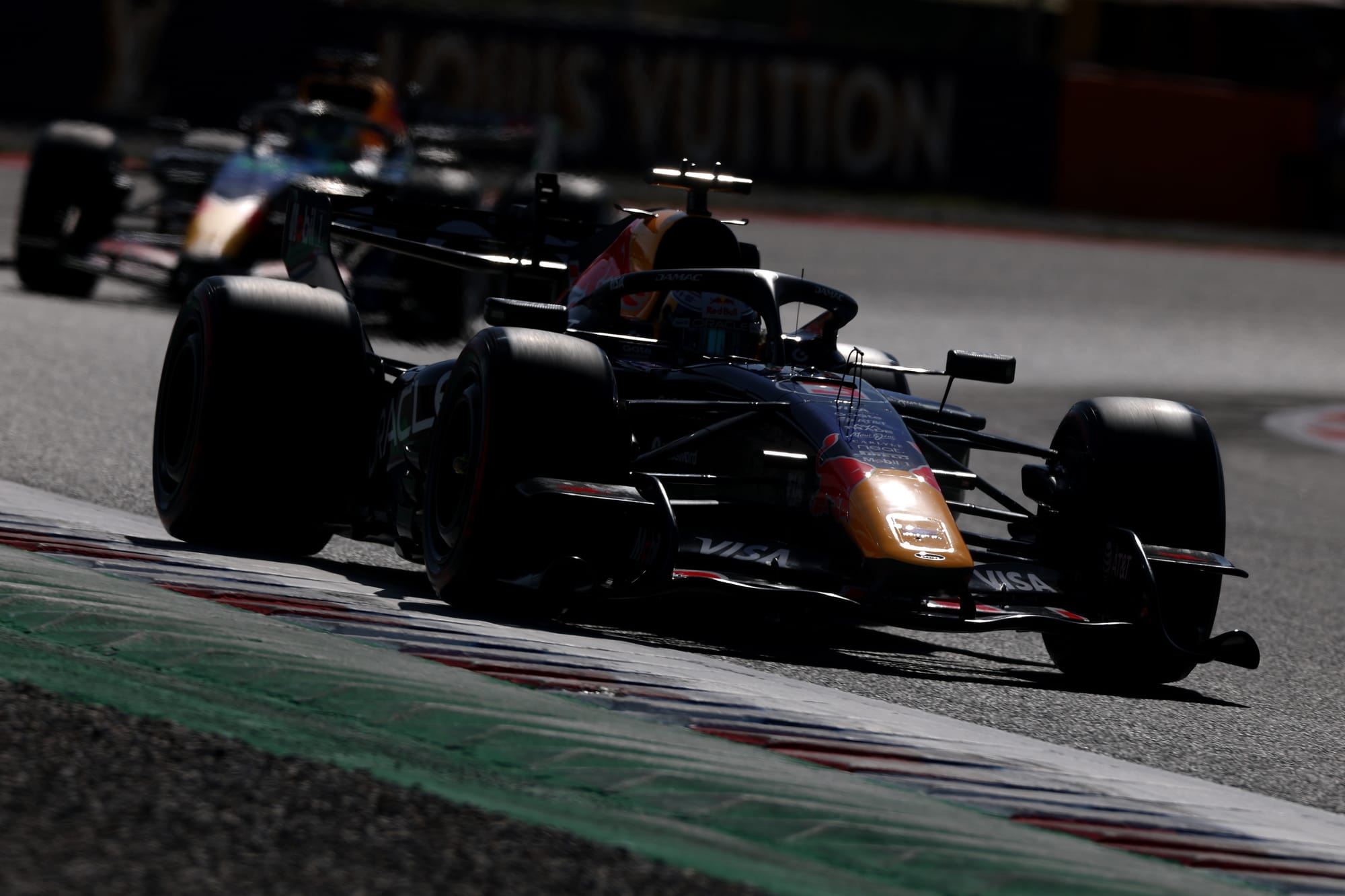
A meeting between Red Bull CEO Oliver Mintzlaff and FIA president Mohammed Ben Sulayem in Paris this week has highlighted how the energy drinks giant is leaving no stone unturned in its quest to understand why it has been judged as having Formula 1's best engine.
The revelation by The Race on race day at the Monaco Grand Prix that the FIA has judged Red Bull to be F1's benchmark right now, so not eligible for upgrades, has caught senior figures at the team by surprise.
Red Bull driver Max Verstappen even said that the team had been "confused" by the findings when first told.
That is because, based on its own analysis, Red Bull has long been convinced that its internal combustion engine - the sole element that the Additional Development and Upgrade Opportunities (ADUO) ranking is based on - is around 0.2-0.3s adrift of the Mercedes.
Team principal Laurent Mekies admitted back in April: "What we see is certainly Mercedes, a long way ahead of most of us."
Red Bull therefore does not understand why the FIA's ranking has resulted in Mercedes being deemed to be at least 2% adrift of it.
While senior management has not said anything in public, it is understood that behind the scenes there has been a concerted effort to push the FIA for a detailed explanation about how it came to its conclusion.
This quest for clarification has, as first revealed by The Race, prompted the FIA to agree to review the data from the opening five races of the season to be doubly sure that its ranking is correct.
Sources have suggested that key to the issue is the accuracy of the data that the FIA has got from the torque sensors that have been installed on all cars to monitor power levels at each track.
Any discrepancy or lack of consistency here could be enough to skew the final results.
While the FIA is expected to take a week or so to complete the review of its analysis, the very top level of management at Red Bull is not sitting back - well aware of the implications of it being confirmed as F1's best engine.
Being judged as such will mean not only being unable to improve its power unit right now, but it could consign it to be restricted from doing so for a long time.
The rules allow manufacturers awarded ADUO to bring improvements in areas outside of the internal combustion engine element that the ranking is based on.
So if Red Bull's rivals are clever, they can make the overall performance better but keep their engines the same - meaning that Red Bull will always be judged to be ahead so could never be eligible to improve.
Against that backdrop, it is unfathomable to think that the topic of ADUO and Red Bull's involvement in F1 was not among the topics that came up earlier this week when Mintzlaff met Ben Sulayem in Paris - pictures of which emerged on social media.
While the meeting was not only about F1 and ADUO, as Red Bull is also in discussions with the FIA about finding a new commercial rights holder for the World Rally Championship, Ben Sulayem did hint that the topic of grand prix racing was one discussed.
"Great to meet with Oliver Mintzlaff at the FIA headquarters in Paris," wrote Ben Sulayem after the meeting on Thursday.
"We discussed Red Bull's significant contribution to FIA championships, in particular its long-standing involvement in Formula 1 and global rallying."
Mercedes welcomes FIA rankings
While Red Bull hopes that the FIA's review of its data prompts a change in outcome, from Mercedes' perspective it has backed the governing body's assessment as being correct.
"In my opinion, when you speak to Nikolas [Tombazis, FIA single seater director], it's data that they have measured and collected," said Mercedes team principal Toto Wolff, when asked by The Race if he thought the upgrade rules were working.
"There's no political background, there are no favours. It's the outcome of their analysis of their torque sensors and the way it's being done, and that is the result."
Wolff was also clear that being allowed to upgrade its power unit that had already won every race was a valuable tool in its back pocket.
"A new homologation is definitely something that is helpful, because if you don't get that, there is quite a possibility of being leapfrogged by somebody else who is able to do this," he said.
"We have come with various ideas in the past, but we shall see how this pans out over the next term. We must not forget this is not a frozen situation, but it's going to be looked at every few races and then being judged upon."
A rules rethink?
The controversy over the Red Bull assessment has prompted thoughts, however, that perhaps the whole ADUO process needs a rethink.
Audi's F1 project leader Mattia Binotto said that F1 might be better basing its engine rankings on overall championship positions - as is done with aero development restrictions - rather than a judgement on power.
"Maybe we should do something very similar to the chassis, where you base it on standings of the previous seasons," he said.
"If the purpose of convergence is to have a closer field, maybe that's the most straightforward, and you would have a unique system framework between chassis and power units.
"So, the best teams not having advantages, the slowest teams or slowest manufacturers to have some more opportunities."
But Wolff questioned that idea, as he suggested that would effectively open up a Balance of Performance (BoP) scenario that F1 has long been eager to avoid.
"I get a rash of allergy when talking about BoP," he said. "This is something that we should stay far away from Formula 1. It's a political mess in all the other series.
"It makes manufacturers go out of the sport also, and I've been very close to that, as you can imagine, in DTM, in GTs, in Le Mans. And we should never be tempted to have someone agree on how the balance of performance should fall out.
"If there is a mechanism that consists of fine-tuning in order to make sure that nobody's embarrassed on the power unit side, I think that's the right way to go, because when you look at aerodynamics, that was invented for a completely different situation."
from The Race https://ift.tt/TYv8gmZ


No comments: