
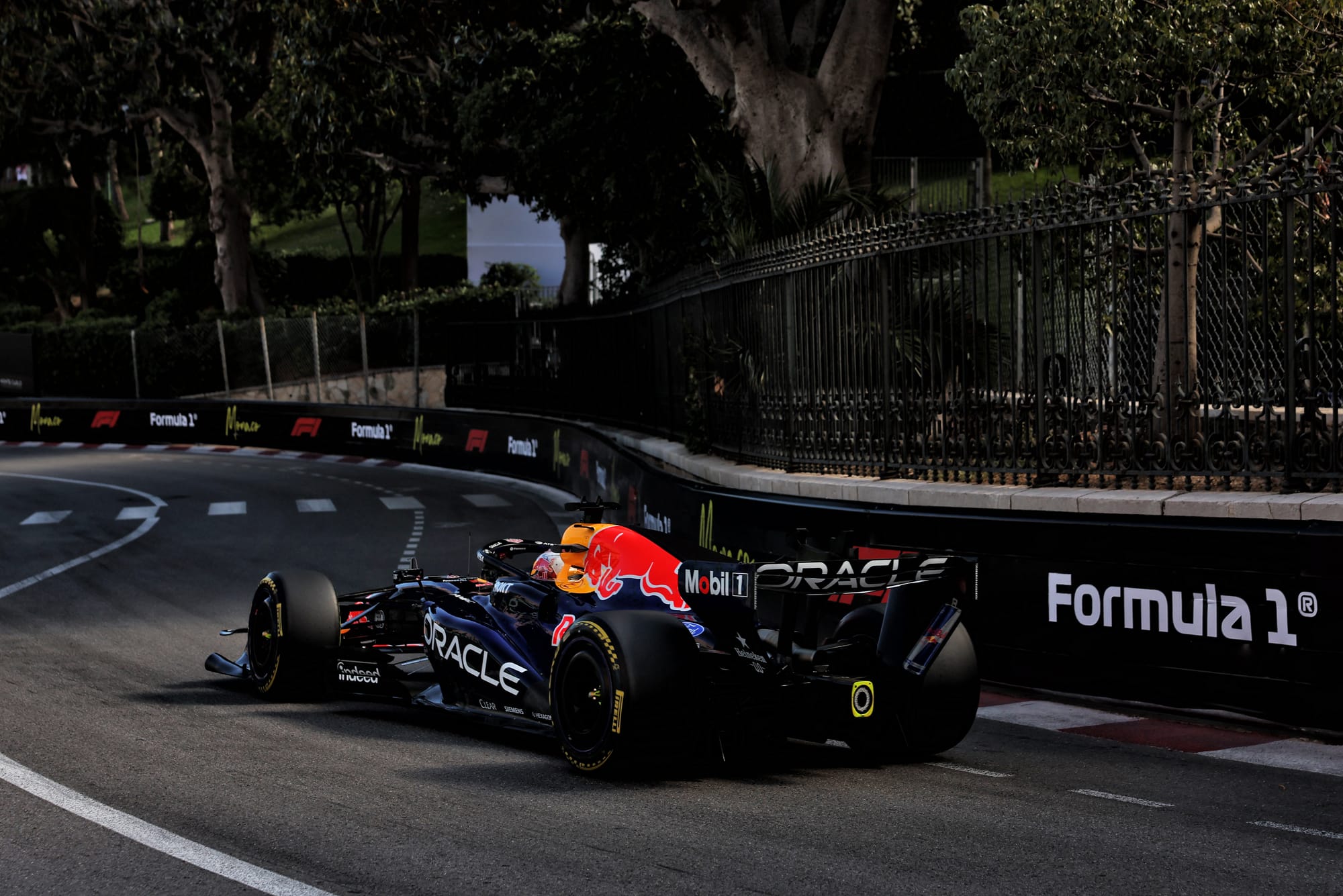
The Formula 1 field has felt somewhat predictable this season, with the impression that there are more two-by-two grids than previously with the car/power unit combination dictating performance even more powerfully.
If anywhere is going to be an exception, it's probably this weekend's Monaco Grand Prix - where qualifying will be more important than at any other event.
But what do the numbers say about the perceived increase in ‘Noah’s Ark’ grids with team-mates lining up two by two up to now?
Firstly, why does this matter? Ultimately, one of the appeals of any sport is there being some degree of unpredictability. A more disordered grid reflects a competition where a driver’s good execution, or lack thereof, would represent a bigger swing in terms of position. Generally, more disorder and unpredictability makes for a more interesting season and presents a greater challenge to drivers as even small underachievement relative to your team-mate should ideally cost more in terms of start position.
To evaluate this, we’re going to analyse qualifying results using several metrics. First, the average position gap between each team-mate pair. This is judged by the qualifying results rather than the final grid, meaning grid penalties are discounted.
The positional gap between team-mates is a more suitable number than the straightforward pace gap, as here we are interested in how ordered the grid is more than the pace gap between cars.
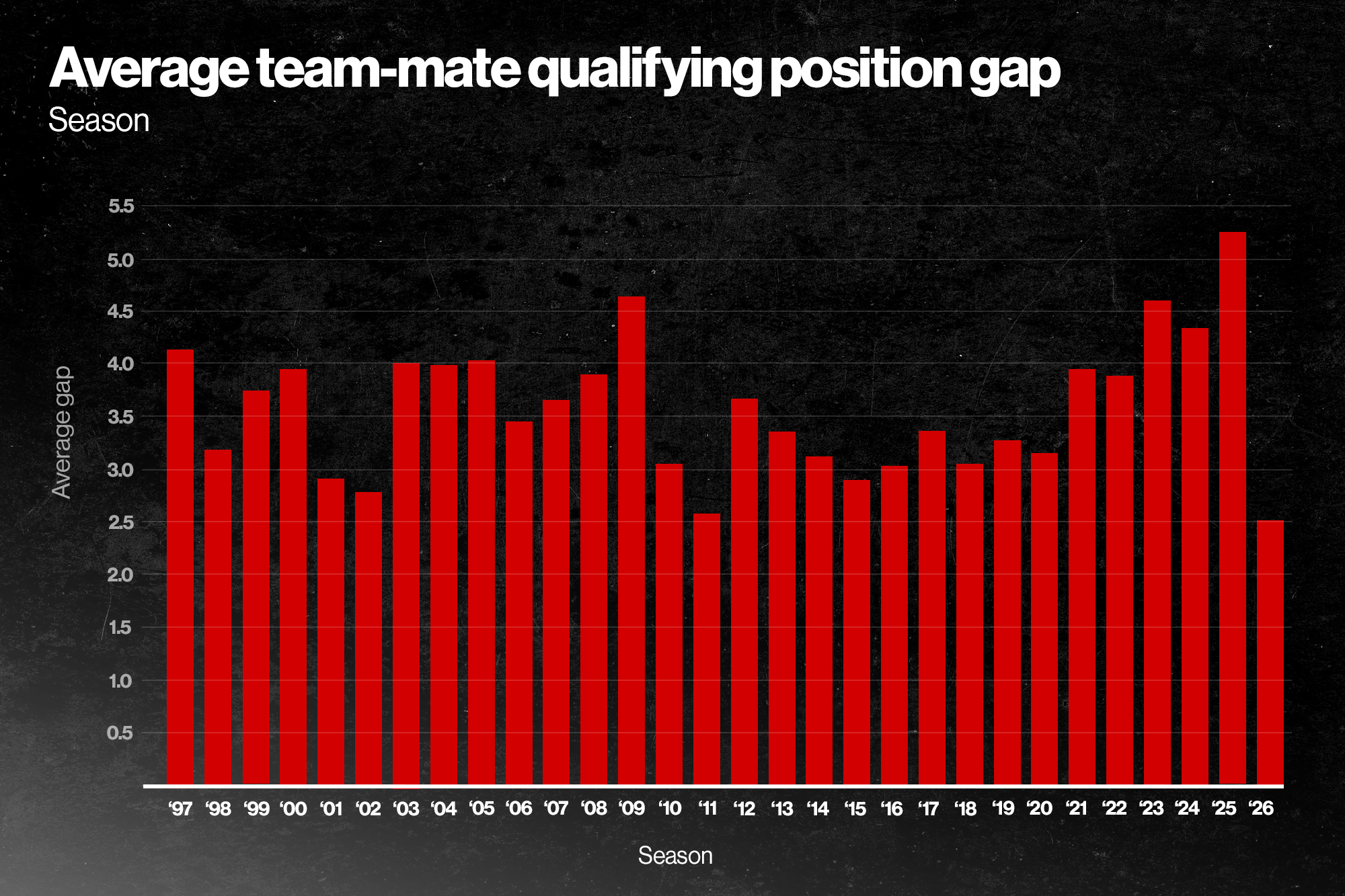
For the eight qualifying sessions so far (five full qualifying sessions and three sprint sessions), the average gap between team-mates is 2.6 places. That’s the second-lowest of the past 30 years, albeit only by the slenderest of margins as 2011 has an average gap of 2.59.
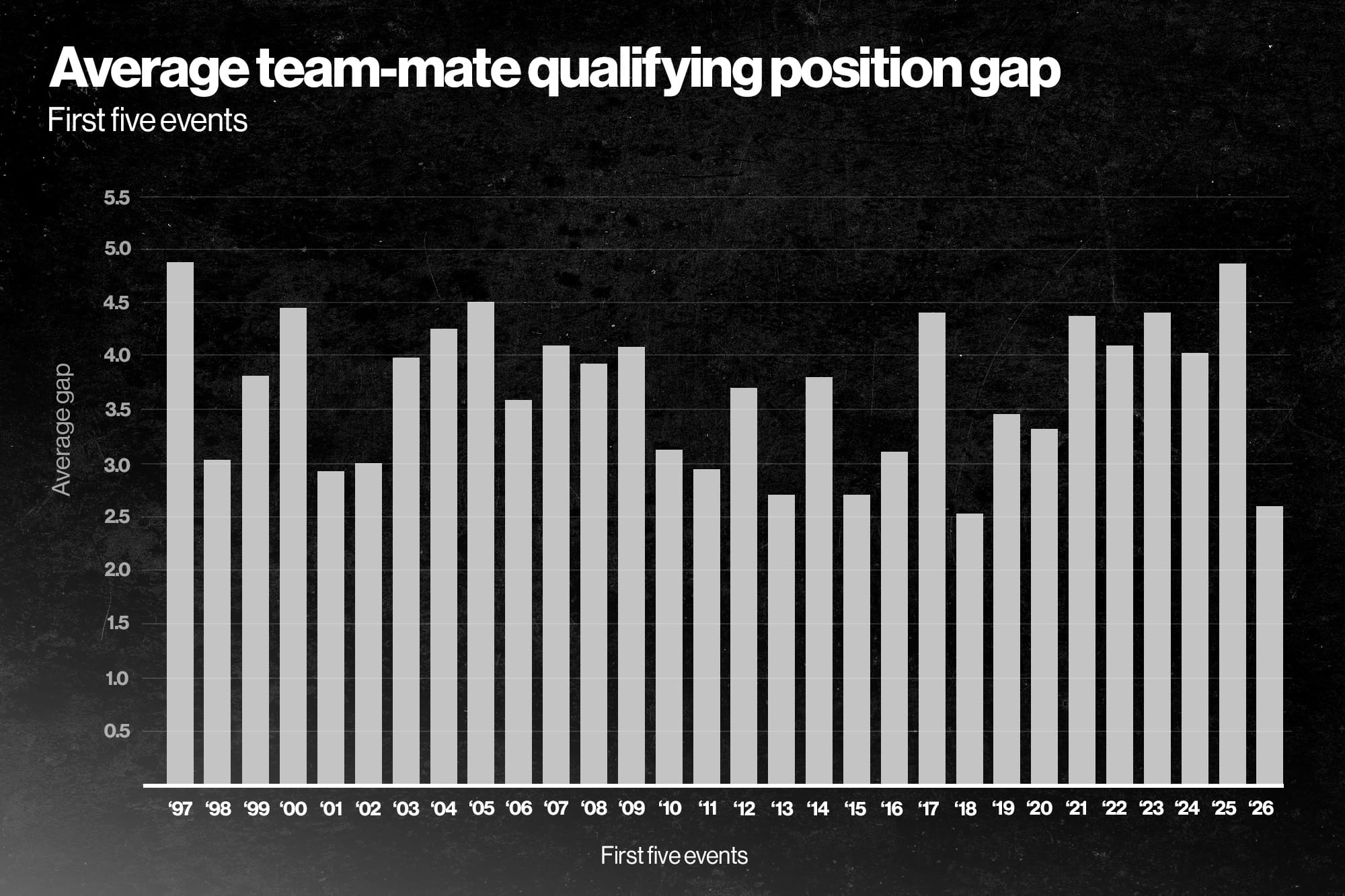
As the 2026 data so far is limited to just five events, comparing the early stages of the current season with complete historic seasons might distort the picture. But data comparing only the first five race weekends is consistent with the bigger picture. Again, 2026 is ranked second, but this time the 2018 season is ahead with a mean gap of 2.53.
The contrast with last season, the final year of the ground effect rules cycle, is dramatic. The whole year produced the largest average gap between team-mates of 5.26, and the second-largest judged by the first five events of 4.87.
Inevitably, the fact that this is comparing the last season of a rules cycle to the first of a new one plays a part in that. But as the historic data shows, the step from old regulations to new regulations doesn’t create as pronounced a swing as might be expected. What’s more, the next-lowest average gap in a season of a major regulations overhaul is 2014, when the 1.6-litre V6 turbo hybrid engines were introduced along with significant chassis regulation changes.
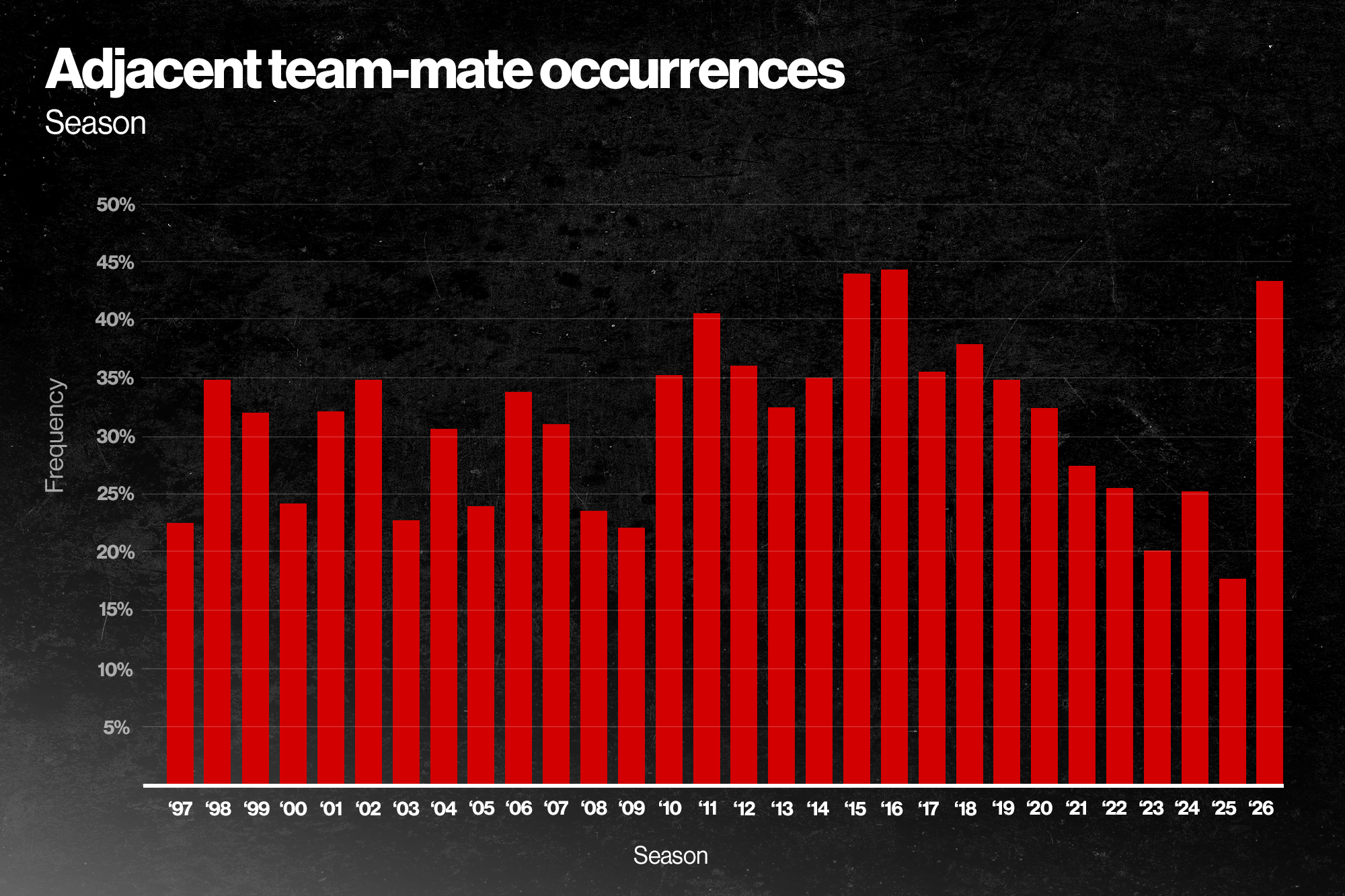
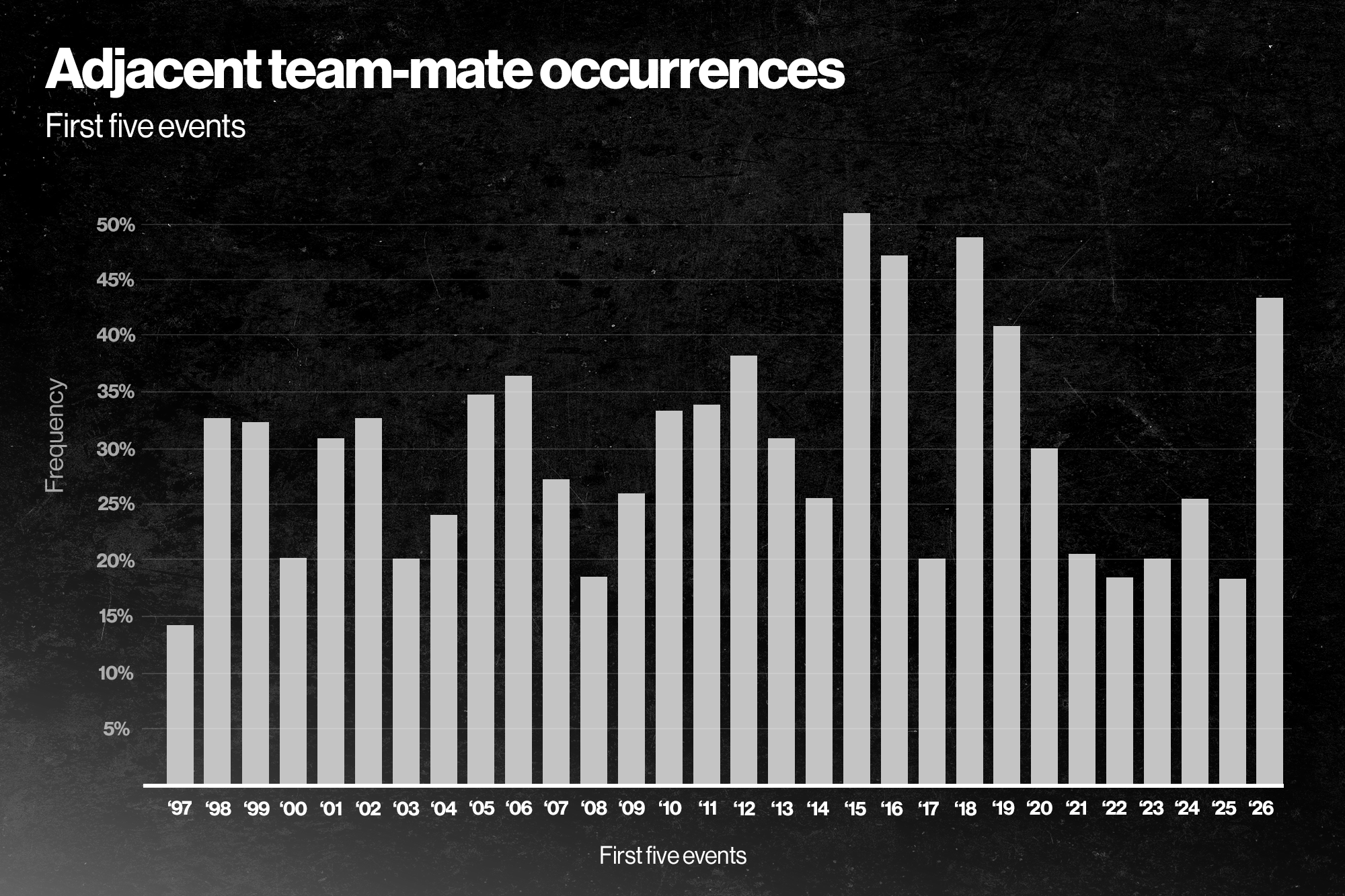
Next we can look at instances of team-mates being next to each other in the qualifying classification. This includes those who on pace qualify on the same row (ie first and second), but also those who are classified together but would be on different rows (ie second and third). On this metric, 2026 comes out third with a frequency of 43.4%. That’s behind 2015, which has a frequency of 43.9%, and 2016, at 44.2%.
Looking only at a comparison of the first five events, it’s a similar story, with 2026 fourth behind 2015 (53.1%), 2018 (49.0%) and 2016 (47.3%).
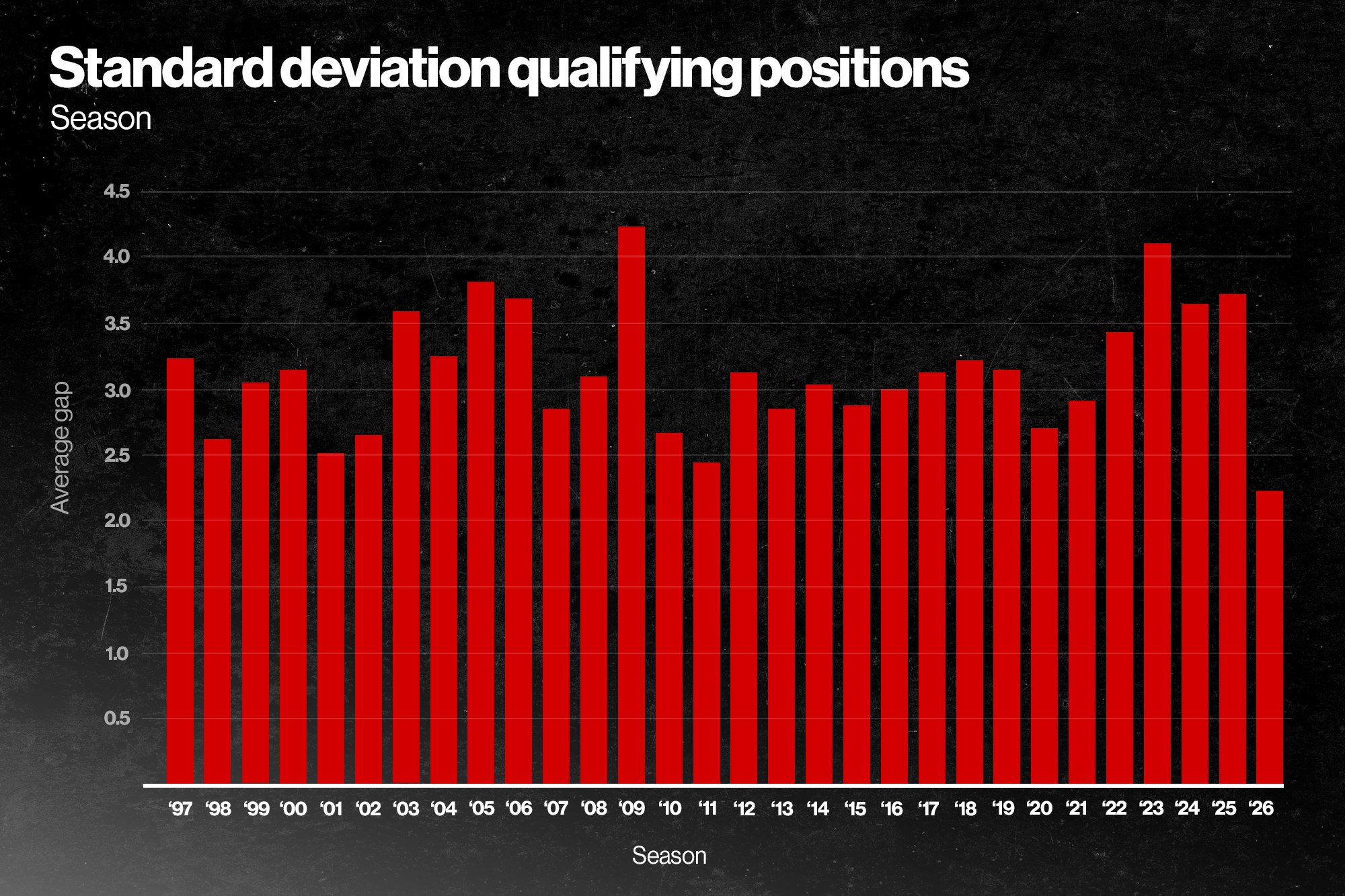
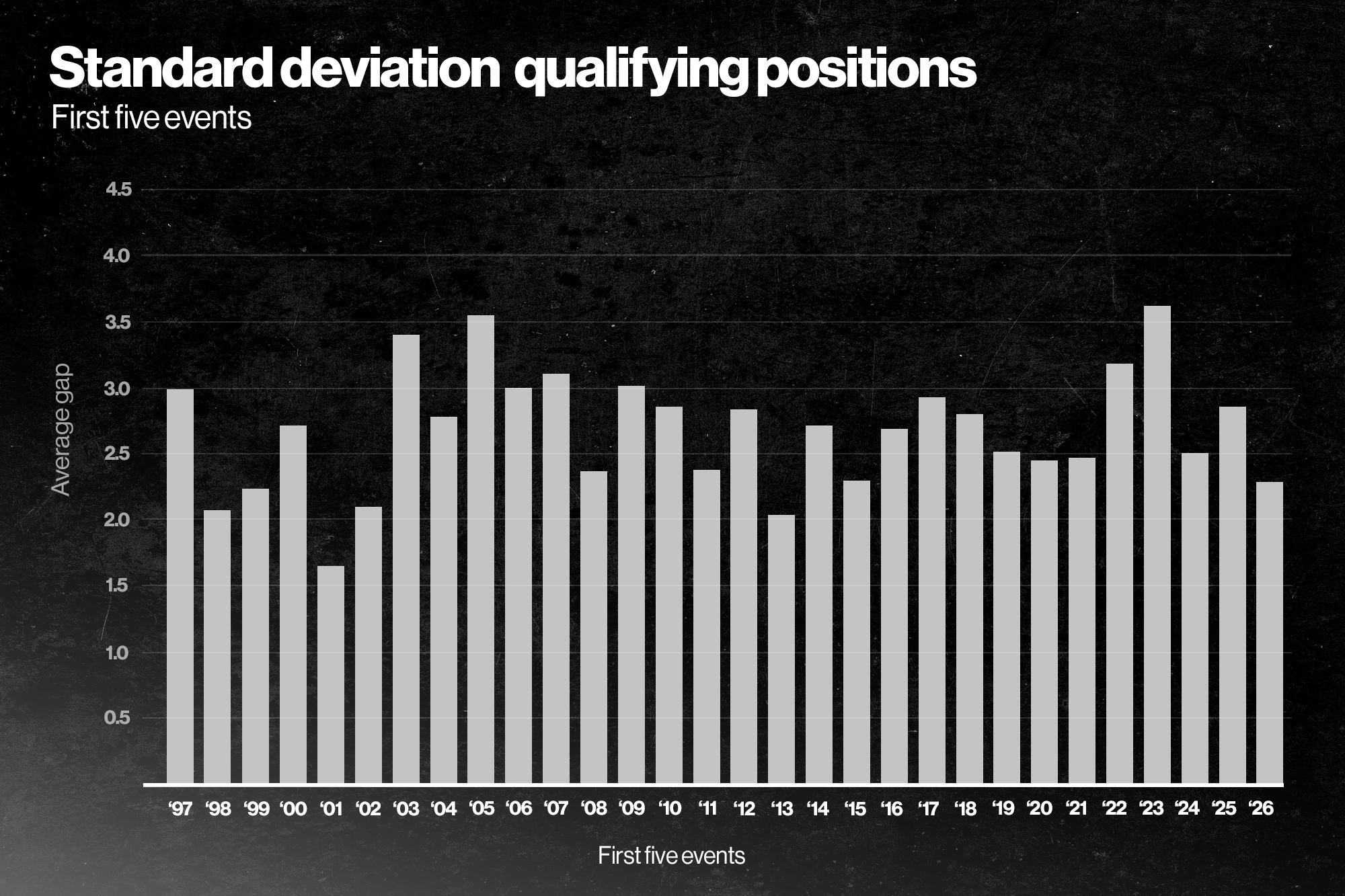
We can also use standard deviation, which measures the spread of a data set. The lower the standard deviation, the more consistent and therefore predictable the qualifying positions are for drivers. So this looks at the overall order or disorder in a driver’s positional results, and the higher the number the more erratic the data set, the lower the figure, the narrower the distribution of results around the average. This makes it a useful measure of the variability of results.
Judged season-to-season, 2026 so far produces the lowest standard deviation figure of 2.28.
Looking only across only the first five events of seasons, the picture is a little different, as 2026 slips to fifth overall. On top is 2001, which has an extraordinarily low figure of 1.65.
It’s still early days and to make a conclusive judgement we need the season to play out to build a bigger sample set of data. But there are indications from the way the season has played out so far that when it comes to the qualifying formation, the car/engine package is potentially more influential than ever in dictating the order of the grid.
That matches the impression from producing the driver rankings after every grand prix, particularly at harvest-poor tracks.
While the high standard of drivers plays a part in this, there’s a negligible difference compared to last year in that given only two seats have changed, albeit with the return of two proven grand prix winners to the field in Sergio Perez and Valtteri Bottas at Cadillac.
One possible reason for this step is the influence of the power unit. While it’s difficult to unravel the multitude of factors contributing to this, both the power unit used and also the variations in how the same engine package is used by different teams are having a significant impact on performance.
While sometimes this creates big differences between team-mates, the variations from team to team are consistent and often the significant time swings are on the straights thanks to deployment variations. Yes, the chassis still matters, as the big pace gaps between teams with the same engines shows, but variations in time gained and lost across straights independent of corner-exit speed are dramatic this year.
That said, the pattern so far is not extreme and 2026 doesn’t lead the way over the past 30 years on all of the data evaluated - in fact, it’s only on standard deviation that it is ranked first. However, it is a trend to be monitored and better understood as the sample size grows, especially as one of the philosophies underpinning the regulations is to create good quality racing. A well-ordered grid will usually result in a well-ordered race, which is why a degree of disorder is a positive.
What is clear is that the predictability of F1 in terms of grid formation and qualifying groupings has risen dramatically compared to the 2025 season. Only time will reveal how much of that is the field-spreading effect of rule changes that will reduce with time and how much is baked into the way the regulations, particularly those of the power unit, have been conceived.
from The Race https://ift.tt/NbGXU2h


No comments: