
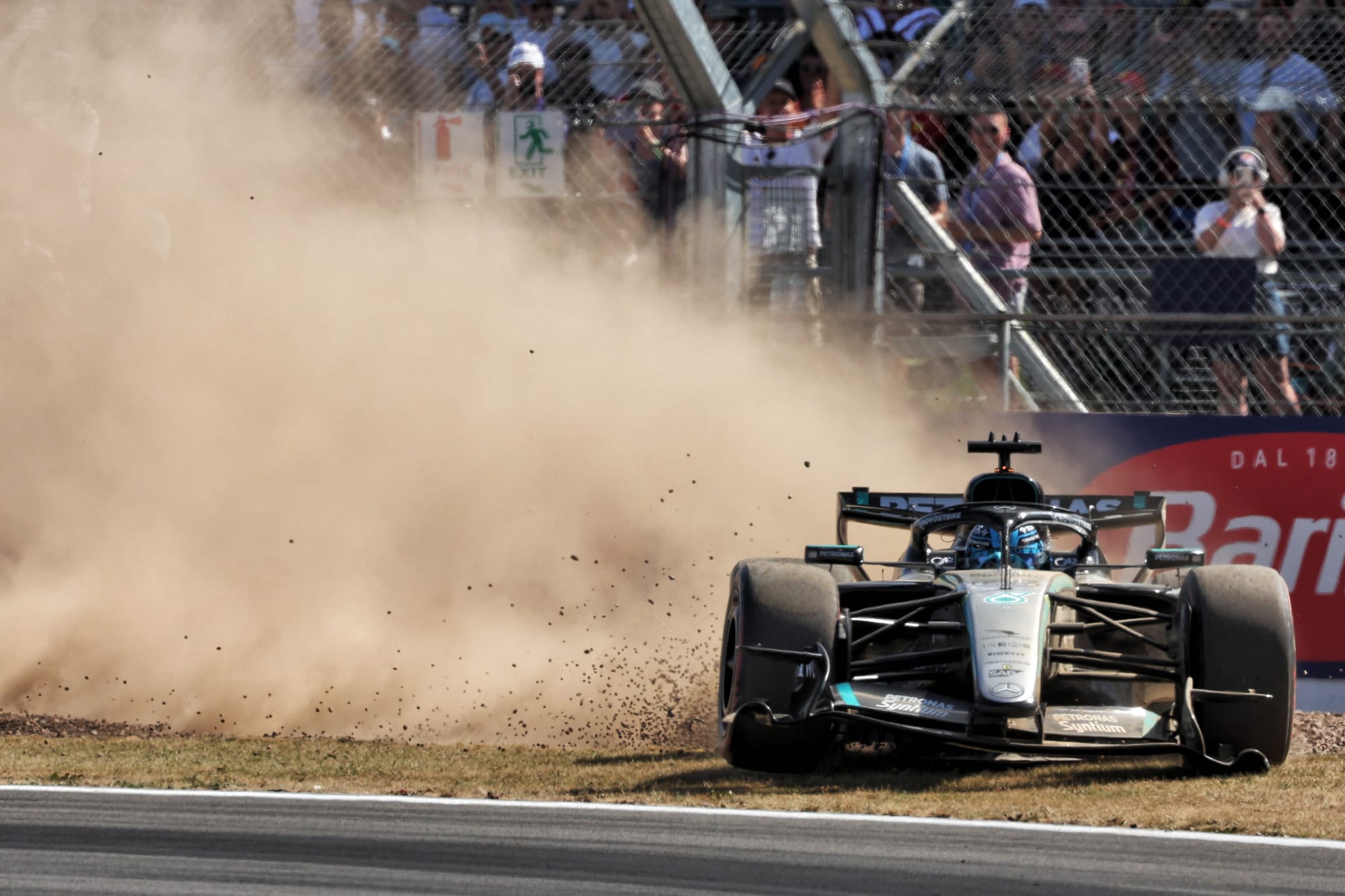
You probably heard George Russell's self-critical comments after taking a somewhat fortuitous second place at the British Grand Prix.
His words made it very clear he's a troubled man at the moment as his Mercedes team-mate Kimi Antonelli - 25 points clear at the head of the Formula 1 drivers' championship - is delivering consistently stronger performances.
"I'm not going to fight for a championship if the performances continue like that," said Russell who in a straight running of the race, before Antonelli's late technical problem and Max Verstappen's crash, would likely have finished a distant fifth, well over half a minute adrift of Antonelli and beaten by two slower Ferraris and a slower Red Bull.
"It is important just to keep on fighting, but the truth is, there's been a lot of things this weekend we don't really understand," Russell continued. "Straightline speed issues yesterday [on Saturday] and on Friday, I think it was better today but the performance wasn't good enough.
"I'm not coming away from this weekend satisfied. I'll take the result, but I would have been more satisfied leaving Canada when I broke down from the lead than I am today standing P2. Just because I probably deserved the win in Canada, and today I didn't deserve to stand where I stood."
That self-assessment may, on the surface, sound excessively scathing given that he won the previous grand prix, in Austria, just a few days earlier. But even in victory, the doubts were there. "I drove in a different and abnormal way to protect the tyres," he said at the Red Bull Ring, "and it worked well. But I need to understand it. I don't have the handle I had on the tyres in previous seasons."
The 2026 tyres are smaller and tend to need higher pressures to support the loads, robbing them of potential grip, especially the fronts. A key Russell strength has always been just how keyed-in he is to high-grip surfaces; he has always been able to fully commit in his braking and corner entries. The higher the surface grip, the more impressive he tends to look relative to others.
It's not that he's usually had a problem on low-grip tracks. After all, this is the driver who put a Williams on the Spa front row in the wet in 2021 with an absolutely sublime lap. But his best performances have tended to be when the track grip is high.
This year however, with these tyres, he struggles to get a flowing rhythm from the car in low-grip situations. Compare his inputs around the super-hot Miami track to those of Antonelli and they are more jagged, correcting more emergencies, reacting rather than feeling.
This has further implications under the 2026 power unit regulations - especially at an energy-starved track such as Silverstone. Energy starvation and a hot, low-grip surface really exposed Russell's difficulties, even magnified them.
Comparing his final Q3 lap with that of Antonelli, they are quite even until they arrive at Hangar Straight relatively late in the lap. They enter that straight at the same speed (250km/h), but Antonelli's car then accelerates harder immediately, peaking at 303km/h compared to Russell's 298km/h. Being slower all the way down Hangar loses him 0.157s.
They go through Stowe at the same speed, but in the short run from there to Vale, Russell loses another 0.067s - and then bleeds further laptime under acceleration between Club and the start/finish line, ending up 0.364s slower over the lap.
So it's a power issue then, running out of electrical power sooner towards the end of the lap? Yes, sort of. But the shortfall is derived from what he's doing in the corners.
Brooklands-Luffield is a good example. Although they get through that section in much the same time, Russell's run through Brooklands is clearly not as good as he drops an extra 10km/h on the exit, meaning he has more accelerating to do between there and Luffield, using up more of the battery's store.
They deploy very similarly through Woodcote and along the old pit straight to Copse and at this stage their laptime is near-identical. But through Becketts, the same pattern: Russell brakes more, loses more momentum, which has to be re-accelerated on the exit. Hence he runs out of deployment earlier on the Hangar straight and is bleeding laptime every time there's a straight stretch for the rest of the lap.
Russell has been on the brakes for over 11% of the lap, Antonelli just over 9%. All that lost momentum from the extra braking has to be re-accelerated, and that costs battery power.
The extra braking arises from that lack of feel from the front tyres. He does not have the confidence needed to fully commit because he isn't getting the messages he needs on a low-grip surface. The time loss of that compounds in this regulation set - and really compounds on an energy-staved track layout like Silverstone. But that's just the technicalities. The effect that has on his psyche when his team-mate is quick on any surface, anywhere, can only be imagined.
But that's what sports competition is; intense mental pressure. Antonelli was probably going through it last year when Max Verstappen was said to be interested in joining Mercedes just when Russell was consistently outperforming the rookie. Russell is good enough to bounce back from this, but he has to decode the mystery first. It's all in there in the data, just as Charles Leclerc's difficulties at Ferrari were.
Antonelli is special - as I've maintained from day one - but that doesn't mean he's impossible to compete with.
from The Race https://ift.tt/0iohasE


No comments: