
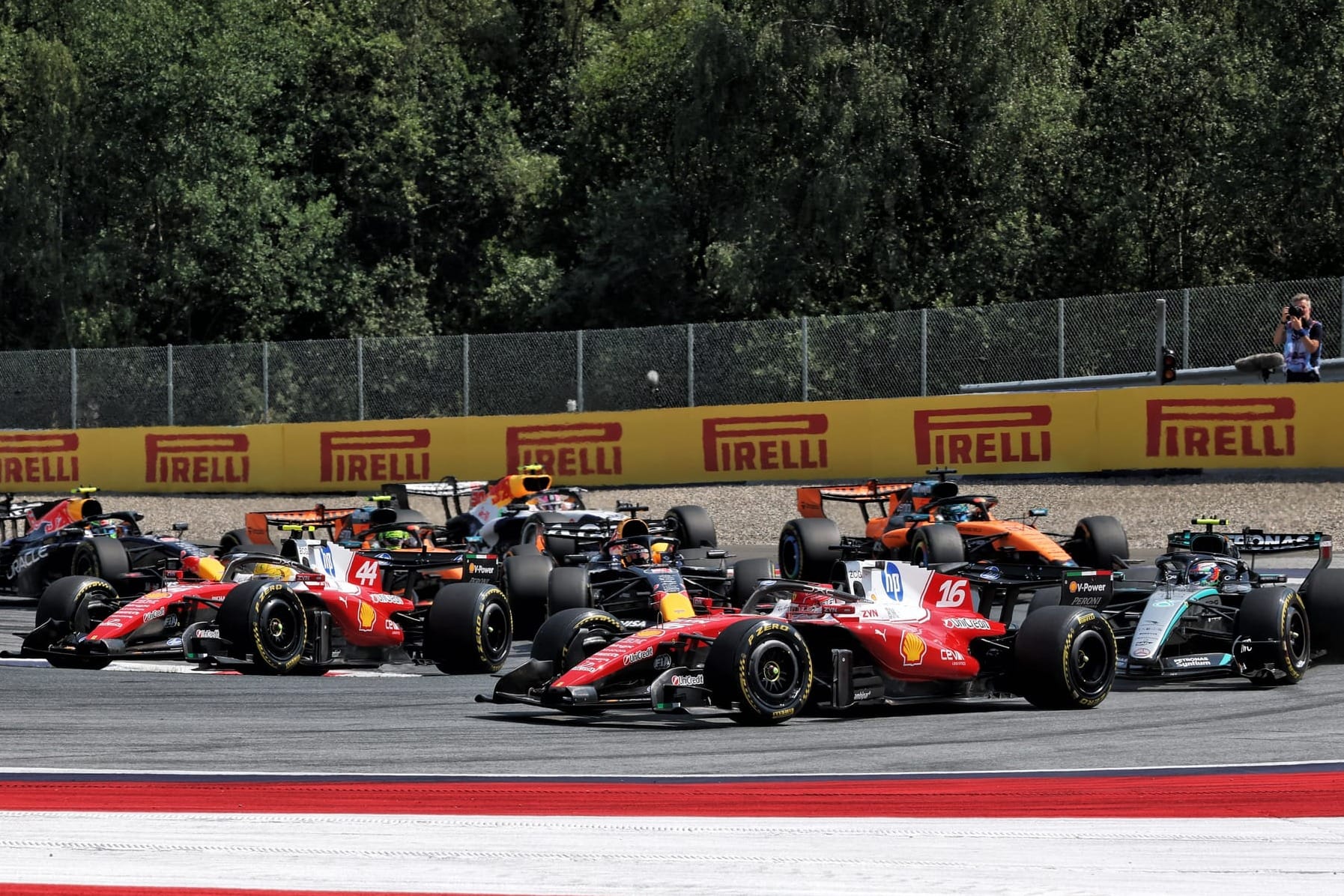
Critical to the outcome of the title battle, and running at a level of aggression that one team boss says he has never seen before, Formula 1's 2026 development war is fast becoming a bone of contention in the paddock.
Fuelling the unease is a sense of frustration from some teams that, under the cost cap, their hands seem to be tied in being unable to spend on the developments they want to bring - while others seem unbound by budgetary constraints.
On Sunday night at the Austrian Grand Prix, after an upgraded Red Bull had pushed Mercedes hard for the win a fortnight after Ferrari had beaten it in Spain, team principal Toto Wolff questioned how some of his main opposition were doing things.
"On the chassis, we're always bringing small enhancements here and there because, simply, we're a little bit surprised that Ferrari can throw these huge updates at the car in the way they do," he said.
"In my opinion, they need to be running out of money soon - cost cap money - because we can't do that.
"We're simply lacking the buffer in cost cap to be able to bring so many parts in the way they do."
A quizzical eye at the behaviour of rivals is something not just reserved for the front of the grid, however, with Fernando Alonso reckoning even Aston Martin's nearest rivals also seemed to have more open wallets.
Speaking about being told by his bosses that they would not be spending anything on early season improvements, Alonso said: "Apparently there is no money to bring upgrades, unlimited upgrades, like the other teams do.
"It is surprising to see the FIA page on Friday every race - because maybe they [other teams] have the money machine in the minus one [floor] in the factory."
Cost vs performance equation
Of course there is not really a magic money machine that teams have, as the FIA is now well-versed in policing the cost cap and making sure that squads are not finding clever ways to get around things.
The issue at play is ultimately one of efficiency of spending and the clever targeting of performance gains, focusing on a cost-versus-laptime boost metric.
By being well-planned, methodical and structured in what parts they focus on and when to bring them into play, plus finding gains in areas that are not super-expensive, teams have a route to being able to do more than others that are perhaps not as meticulous.
Wolff said there was one clear outlier among the 'big four' teams right now.
"The only ones that are not slowing down [development] is Ferrari," he said. "Between McLaren, Red Bull and ourselves, you can see we had one big one [upgrade] that we introduced in Montreal.
"We have small parts that come in-between. I think the same for Red Bull and McLaren.
"It's just Ferrari, who seems to be limitless in that way. And then on top, they were expecting ADUO [Additional Development and Upgrade Opportunities allowances] and come with a new engine already. So they must have started to develop that six months ago."
Ferrari team principal Fred Vasseur said the early ADUO-assisted engine step that has been added on top of the car development was done for cost cap reasons - but in terms of bringing its spending down rather than burning through more of it.
Introducing that upgrade in line when the next round of engine swaps were taking place - Mercedes installed fresh, same-spec power units in Austria as well - meant there would not be unnecessary spending later on this year in bringing an extra out-of-sync step.
"The lead time on the engine is huge," said Vasseur. "On some components, you have months of delay.
"It was very risky for us to launch the ADUO, at least the spec two of the engine, very early for cost cap reasons. We were not expecting at all a big step this weekend."
The topic of the cost cap is starting to gather momentum because the evidence from the first part of the year is that upgrades are so powerful these days in swinging the competitive order that teams need to keep them up.
McLaren team principal Andrea Stella said: "I think what we see in 2026 is a Formula 1 operating at a level that has never been the case before.
"Cadillac, probably at this circuit, was the car that was most significantly upgraded, actually. The laptimes were more competitive.
"If you see the upgrades that Red Bull did, they are quite voluminous. So the overall game in terms of pure performance development, but also performance delivery to track, is to a higher level than I've ever seen before."
While the first rumblings over cost-cap spending have not stirred up into a full-blown controversy yet, that could change if the apparent endless spending of some continues unabated over the remainder of the campaign.
It is one thing front-loading development and outpacing rivals over a segment of the season before the cash runs out and the developments have to stop.
It would be quite another to be churning through the upgrades at a faster speed than others and then continuing to be able to do so as the season winds down while everyone else has to turn off their development taps.
Red Bull team principal Laurent Mekies said he had seen nothing too unusual right now, as what has played out so far could be explained by squads choosing to front-load development spending.
But the questions will come later this year if those that have made the head start continue to extend their lead.
"We've decided to make the big push as early as we could from an engineering and engineering resource perspective," he said.
"So yes, we have invested a large amount of our development capabilities to try to diminish that gap as early as we could.
"We would like to hope that things will slow down for certainly most of the top teams in the second part. But we may have some surprises."
from The Race https://ift.tt/xPZG9Rv


No comments: