
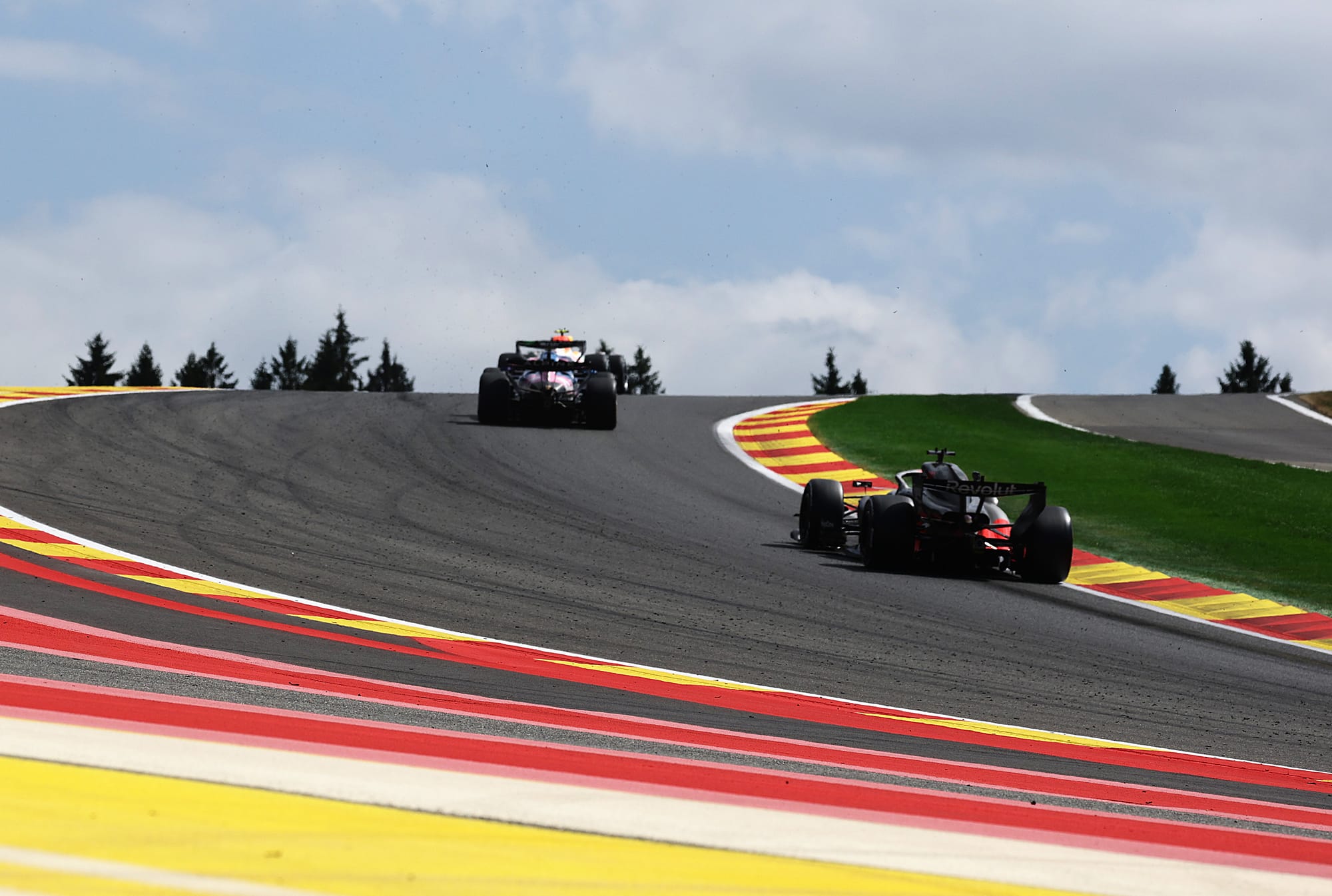
The complex interaction between energy-starved, AI-integrated power units, new-for-2026 tyres and wheels, lower downforce cars, constantly shifting circuit conditions and microscopically variable driving inputs is making it very difficult for anyone inside the Formula 1 paddock to clearly understand where performance is coming from and where it’s being lost.
We’ve heard in recent days how frustrated the drivers have become with what are loosely called ‘deployment problems’ but can range anywhere from ‘driver pushes button at the wrong time’ to ‘driver makes a mistake that makes the MGU-K fill in a power gap’ to ‘AI got confused and made my power unit deploy energy in an unexpected way’.
When some of the finest engineering minds in F1, with all the data and computing power and experience at their disposal, can’t easily figure out what’s going on, it’s almost impossible to expect the drivers to know the right course of action to take.
McLaren team boss Andrea Stella has repeatedly said for a while, in a somewhat enigmatic way, that McLaren is behind the factory Mercedes team on understanding how to best exploit the 2026 engines.
And what he means by this is that McLaren has lacked the sophisticated simulation models needed to pre-programme the power units in the best way, before they begin their AI-assisted learning process at the track.
“When you operate a power unit that is so complicated, and this is complicated because of the regulations, not because the HPP [Mercedes] is particularly complicated, you need models of the power unit itself to be able to test different parameters, and see how the power unit would respond,” Stella says. “But also to optimise the deployment, optimise the driving, and optimise the gears, and so on.
“Some of these tools were not available, just because of a timeline. So we have worked together to make sure that they have become available as soon as possible, and as a matter of fact, now they are starting to be available, and we are definitely taking great benefit.”
But even though McLaren is getting better at predictions, thus allowing Lando Norris and Oscar Piastri to start their weekends more on the front foot, the complicated nature of the way the power units operate, coupled with their incredible sensitivity to external inputs, has made the process of understanding what’s going on in-weekend incredibly challenging.
“Models are a representation in the engineering world of the physical world, or of the physical machines that you use, but these machines include a level of complication that sometimes you don't capture entirely in the modelling,” Stella explains.
“Like you may capture over time, because you sophisticate your models and they become more and more precise. But we are all learning, and I'm sure every power unit manufacturer, they are also learning, as to how to represent from an engineering point of view, the physical machines that they have made. So I think this is one element, the modelling.
“This would not be a problem if the power units themselves wouldn't be so sensitive to lack of fidelity. Because we said already that there's an effect such that a little change of a driving input would have a big change in terms of outcome. Likewise, a little change from the physical behaviour of the power unit parts may lead to big changes in outcome.
“That's where the modelling comes into [play]. Like representation of the physics, and representation of driving input, or even wind.
“I think we have heard, especially from the Mercedes drivers, that they kind of make adaptations to the grip. They adjust, they set things to the grip through qualifying.
“This means that things are so sensitive to some parameters, that you should represent all this in your models. And this is very difficult, and it will take some more time.”
These three factors: wind, track/tyre grip and driving input have always been crucial in F1, of course, but the way they can influence the performance of these 2026 power units - and in particular the machine learning they are now doing - is unprecedented.
An increased headwind on a straight between sessions or between qualifying runs, for example, can effectively increase the length of that straight by forcing a given car to spend longer on it, which then can impact the distance-based deployment equation.
The drivers are then having to adjust their inputs dynamically to compensate. Again, not something new in itself, but the way these AI power units respond is so unpredictable that many drivers are struggling to make those adjustments correctly, feel them, or even know the degree of adjustment required.
According to Stella, “you need to be able to anticipate and make sure the operation of the power unit unfolds as expected, because this is not only for the influence it has in the power-limited sections, in the straights, but also because it affects the braking points, because if you have an additional amount of harvest with a super clip before braking then you are approaching the braking 10km/h slower, and your braking point changes.
“This is quite difficult to master, I would say, for the drivers, and it's one of the reasons why I'm sure the drivers as well, they talk about the difficulties from a driving point of view to exploit the power unit.
“It's not only to get the most out of the power unit, but also because the variations of the power unit affect the references as you approach a corner.”
There are further complications in terms of required driving style this season too, because downforce levels have dramatically reduced and the Pirelli tyres (and the wheel sizes they attach to) are also different.
By default the drivers have much less front grip available, and the past way of countering this as a driver - by braking hard and late, forcing the front of the car to pitch forward, and then achieve rotation in the slow and medium speed corners - is not so readily available.
Braking distances are longer, the speed at which the cars approach corners tends to be reducing already because of the need to harvest energy into the battery, and drivers are also often shifting down additional gears to help recycle energy into the battery and keep the engine RPM at the correct level to keep the turbo spinning to avoid lag. This ‘engine braking’ effect can both slow down and unsettle the car.
Drivers able to find a way around this chronic understeer - something that was present in the previous generation ground-effect cars until Pirelli modified the front tyres - are probably at an advantage. And it's no wonder plenty of teams - most recently Haas at Spa - have introduced front wing updates to try to counter this understeer.
Corner speed is still important, but it’s no longer really about bravery in the fast corners and dexterity and ability to handle rear instability in the slower ones. It seems more like walking a tightrope, using all the tools you have available as a driver to try to keep the engine revs at the right level to keep the turbo spinning at the right level, trying to prevent the MGU-K from automatically compensating for any imprecision.
“To operate these power units, you don't operate them in an open-loop way, whereby I would be able to have an offline simulation and say, ‘oh, that's how the electrical power will be deployed, and it will always be identical to itself’,” Stella says.
“There's a large component of the controller that operates the power unit that happens with live calculations, and the power unit kind of forward thinks, forward calculates what it has to do.
“It definitely kind of learns, but the variations that are significantly relevant are so small that they may happen from one lap to the other, even if you have learned from the previous laps.”
And so even if you think you have correctly judged the prevailing wind, and the grip levels, and you think your driver has driven the right way to make the power unit deploy its energy correctly, the machine inside the power unit may anyway decide it has a different opinion.
from The Race https://ift.tt/vlh8g4c


No comments: