
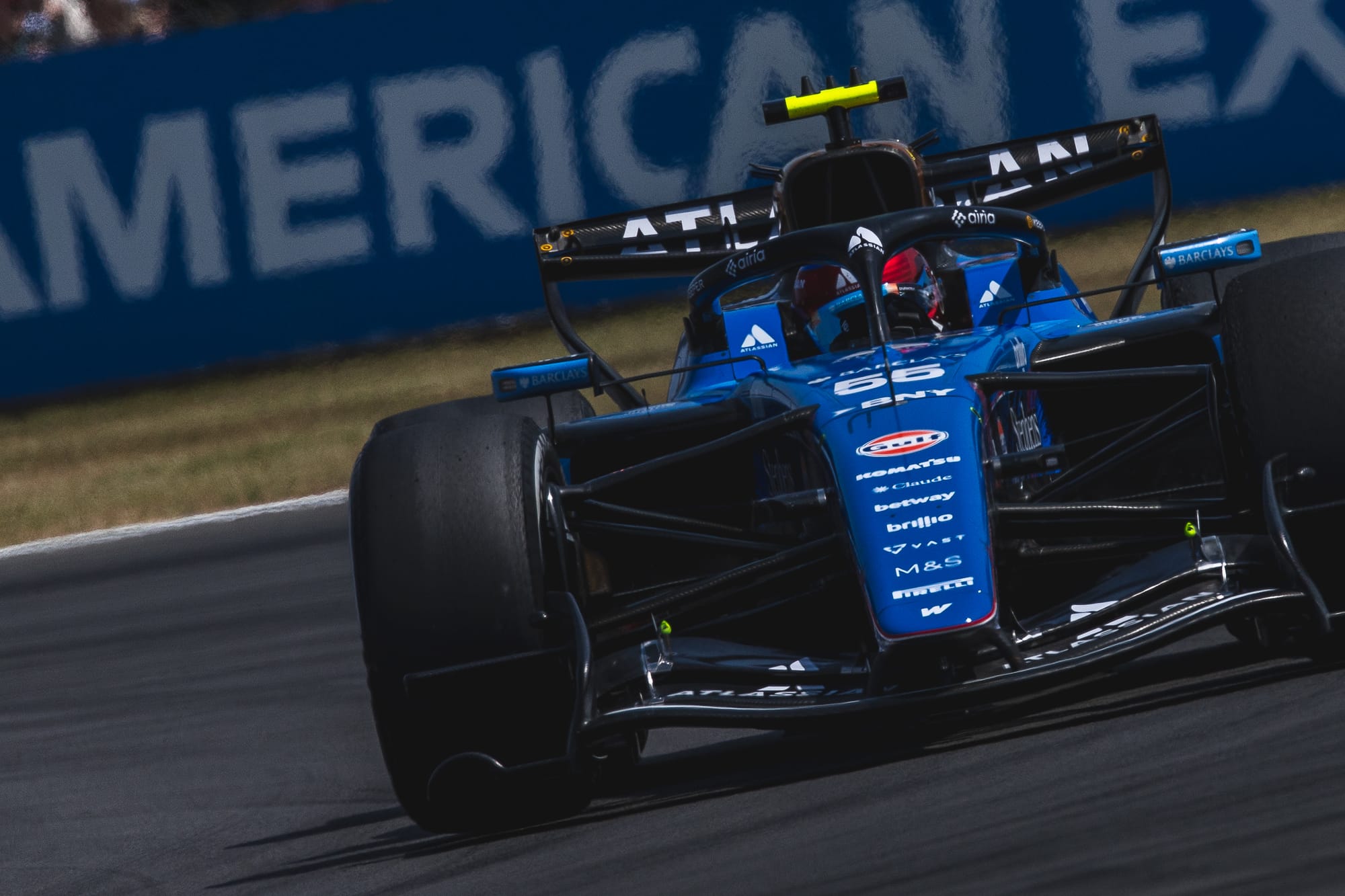
Carlos Sainz is concerned Williams’s Formula 1 team might be going backwards, rather than properly recovering from its miserable 2026 start.
Sainz had high expectations that Williams would make a strong start to F1’s new regulation cycle, having been one of the first teams to switch its full focus to 2026 development last year.
Yet in reality Williams is only eclipsed by Aston Martin Honda’s woeful start when it comes to the biggest disappointments of the season.
Williams’s biggest initial weakness - a horrendously overweight car, up to 28kg over the weight limit - has been well-documented, but now that the team is removing some of that weight, Sainz has raised fresh concerns about the state of the team, even with a lighter car.
Sainz had already said in Monaco that the team’s tricky start to 2026 tested his faith in the project, but the Silverstone weekend prompted Sainz’s most damning criticisms yet.
Sainz made a good start in the grand prix to rise from 14th into the top 10 on the opening lap, but the Alpines and Audis - remember, the teams Sainz rejected for Williams two years ago - were “simply too quick for us”, dispatching Sainz with ease.
“Concerning, frustrating because it starts to be a bad trend this year that we don't seem to really find a lot of laptime when the upgrades are coming,” Sainz said.
“We need to have a good sit-down now this week and analyse what's happening because unfortunately, we've shed a lot of weight out of the car by now. But the gap to the front keeps increasing and the gap to the leader of the midfield keeps increasing.
“So we don't seem to be finding the laptime that we expected in the winter.”
Williams fast-tracked a new front wing for Silverstone that was originally targeted for Spa. The 2026 car’s problems went well beyond the weight, with both drivers complaining of significant aero balance issues throughout the season, as well as a general lack of good old-fashioned downforce.
The new front wing was supposed to deliver a small step forward, following on from a big package in Miami, which took a chunk of excess weight out of the car.
“We definitely felt that this front wing was a big step forward in the windtunnel and the simulator, and we expected definitely more, more of an uplift from it in performance,” Sainz explained.
“Unfortunately we haven't been very competitive this weekend.”
Sainz is baffled at Williams’s apparent in-season regression.
“I don't know if with this set of regulations we're not understanding the flow dynamics and the flow aerodynamics well or what is happening,” Sainz said.
“But my feeling is that at Suzuka we were 1.6, 1.8 seconds with a very overweight car. [At Silverstone] we're two seconds off with a much better weight.
“It means that something is not going into the car. There's some load there missing somewhere.
“We need to go find why and we need to be serious about finding the issues and create some bounce back from here.”
Is Sainz’s claim right?
One way to measure Williams’s performance in 2026 is to look at the F1 supertimes, the fastest lap of each team’s weekend expressed as a percentage, where 100% is the fastest time of the weekend.
Williams started the season just over 3% off this in Melbourne, something it brought down to 1.984% in Miami, where it debuted a sizeable upgrade package and achieved its only double points finish of the year.
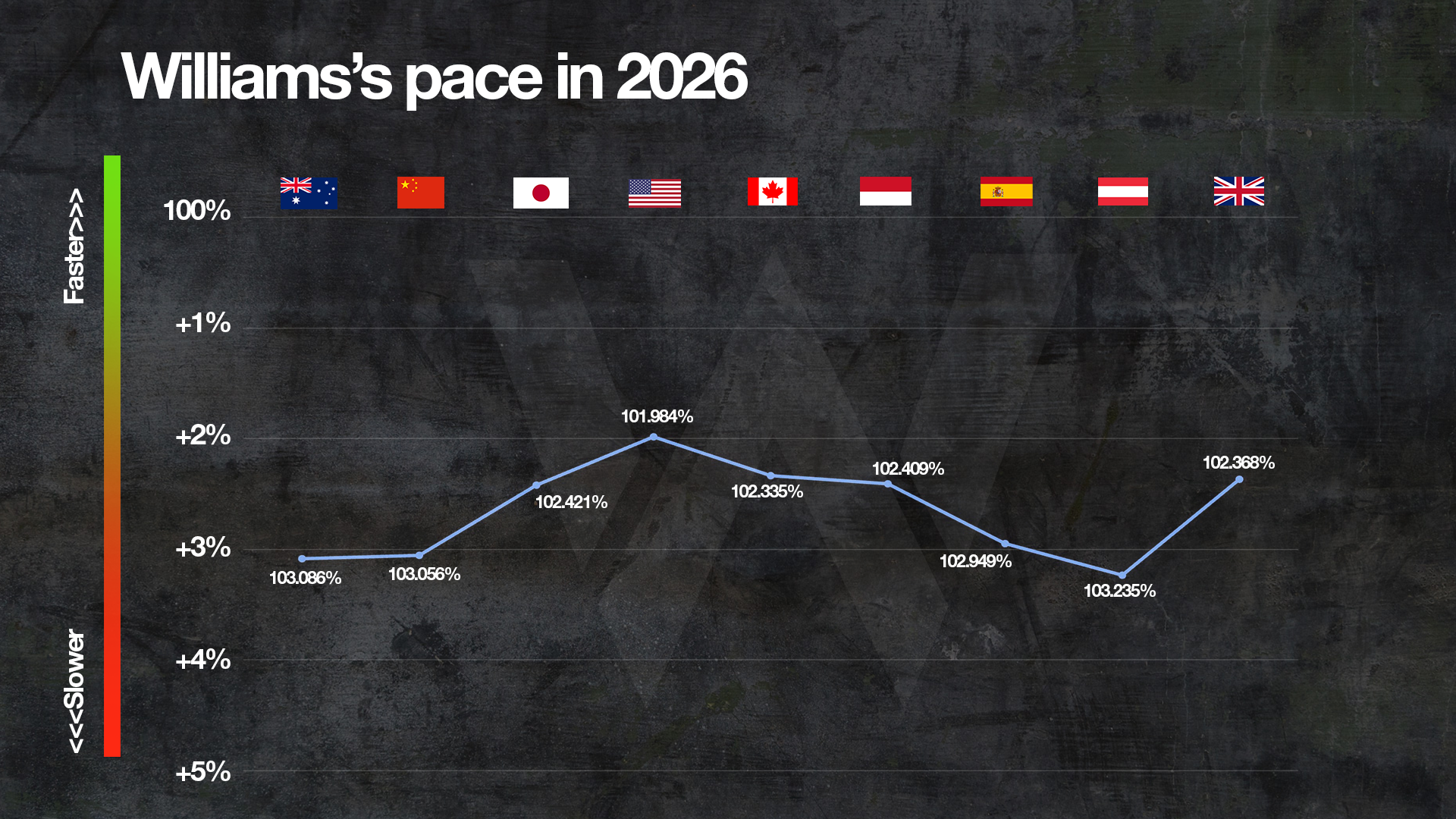
But Sainz is right that Williams seemed to go backwards thereafter, dropping to a low of 3.235% off the pace in Austria - further off than it had been all season!
Austria was the worst-case scenario for Williams. Hot conditions at a circuit like the Red Bull Ring compromise an overweight car even more because of the drag/downforce and cooling trade-offs you have to make. And a heavier car works the tyres harder, so your tyre degradation is worse.
So the deficit improved at Silverstone, but Williams was still further off than it was in Miami, several rounds prior.
That’s despite being the lightest it's been all season, according to Sainz’s team-mate Alex Albon and yet “the performance is still not there”.
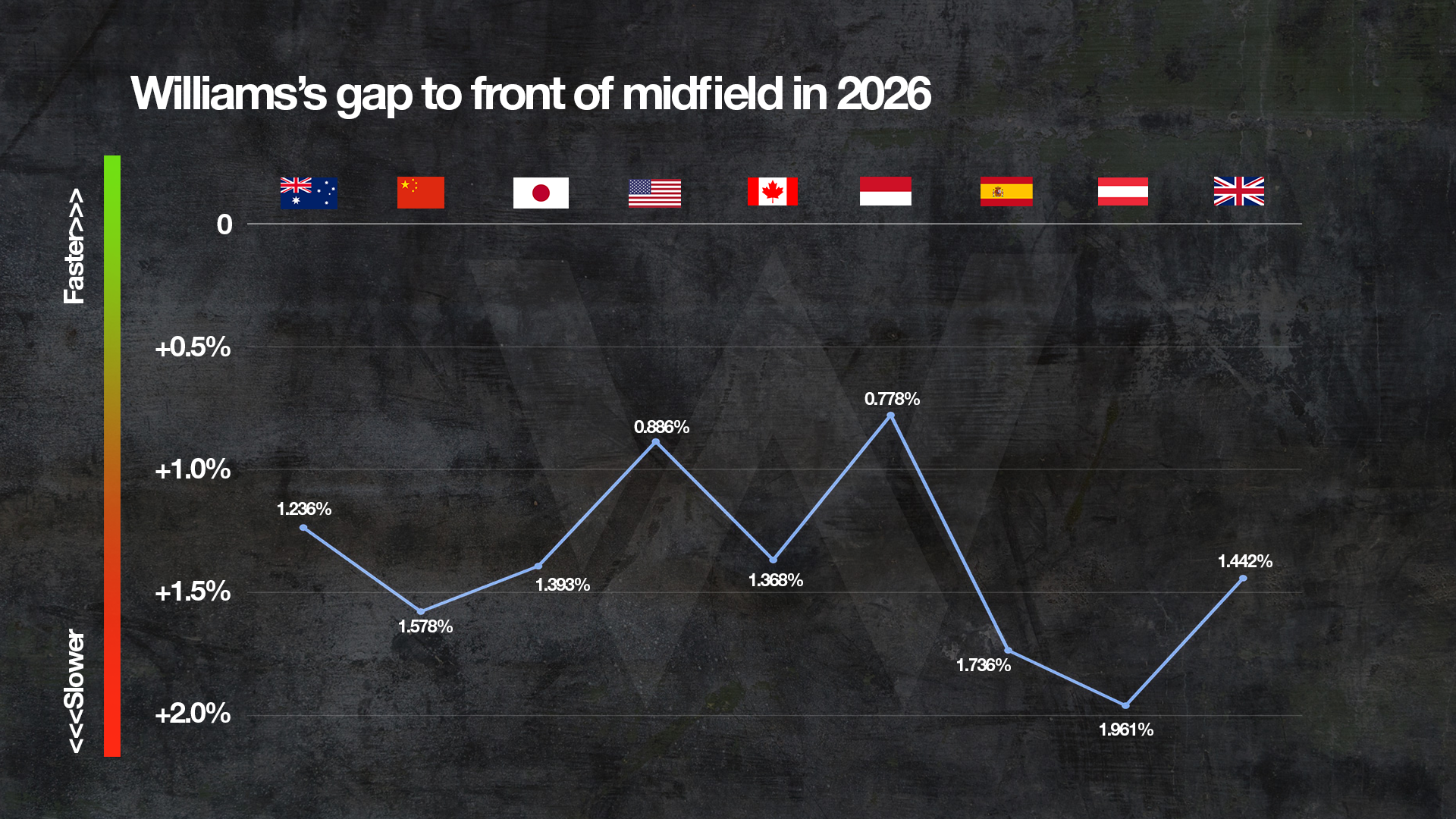
Williams’s gap to the midfield was also worse than ever in Austria and while better at Silverstone, it was even worse there than in the Melbourne season opener and the Japanese GP, as Sainz pointed out.
It’s why Sainz described himself as “upset” and “worried” on Sunday at Silverstone because once again he’d made a strong race start, but found himself powerless to defend against midfield cars, relegating him back to Williams’s natural position.
The other teams aren’t standing still, so even though Williams has made genuine progress since Melbourne, F1’s a relative game, and Williams hasn’t made massively meaningful progress so far.
What’s gone so wrong?
One of Williams’s biggest problems is that the 2026 car build exposed where its F1 operation is still lagging well behind where it needs to be.
Team principal James Vowles has spent much of his three and a half years at Williams trying to metamorphose the team from one that used outdated and inefficient processes into a frontrunning outfit.
But that process is nowhere near completion. Vowles spoke of not being able to trust the data during the 2026 design process, so key problems were identified far too late by Williams’s overloaded internal systems.
Vowles said by the time that data got flagged up, “It was far too late in the process to make corrections” so it fell three weeks behind.
That’s “unrecoverable” without ending up with a massively overweight car as Williams did, a necessary, painful “compromise” to ensure Williams was ready to start the season.
Vowles said further changes will be made to Williams’s processes, but he admitted “they won’t fix everything”.
He contrasted the situation to his former Mercedes team.
“In Mercedes, when you do structural work, you have 20 years' worth of data to the right level, data to the right way that gives you material science and ways of working and information. That didn't exist in Williams. It had two years worth of data in it, effectively, so you have to fill that in,” Vowles said.
“Understanding what capacity you can push through your operations facility is data that's built up in Mercedes for at least 10 years. It wasn't great before 2010 in Mercedes, to be completely clear. It wasn't Mercedes before then anyway. That data we built up in one year, which was this winter. And you can sort of see why.
“Is it just around the processing systems? No, it's ways of working and expertise that go with it at the same time. So there's an amount of learning that you're trying to do whilst building a car at the same time, and not at the rate required this winter.”
In terms of that expertise, Williams couldn’t attract the talent that it wanted to until it started delivering on track, something it did effectively in 2025, becoming F1’s clear midfield leader.
But Vowles said there’s often a two-year lag with personnel arriving, so a lot of the new arrivals couldn’t have a direct impact on the 2026 car.
Williams’s new supply chain is also in its early days compared to Mercedes’, the latter of which has formed decade-long relationships with many of its key suppliers.
Vowles also spun a positive out of the painful 2026 build.
“But never let a good crisis go to waste,” Vowles said. “The amount of changes we have made have put us into a very good situation for the future, and I don't think we would have made them if we'd partially succeeded this winter.
“So as painful as it's been, I believe we have to go through it as well.”
That’s spun well, but Sainz will need convincing that Williams was hitting a necessary blip rather than this being something endemic. After all, Sainz is still fully committed to helping Williams turn things around: he was even doing the hard yards in the simulator early on Thursday morning at Silverstone before arriving for media day.
In theory, the changes being made should help its 2027 and 2028 cars, but what of the progress Williams can make this season?
The task of fixing an overweight and slow car in the middle of the season is a challenge Vowles compared to “flying the plane and rebuilding it at the same time”.
And Williams hasn’t mastered how to do that in the most effective way under F1’s cost cap, admitting, “Our efficiency level is not at the level of a Formula 1 team that has an established way of working for 10 years.”
He summed it up as “it will cost more money and take more time in order to produce parts” compared to the top teams.
So making big gains on them in-season with much of the same infrastructure is difficult, but Williams has its hopes pinned on a huge upgrade arriving in a couple of months.
A B-spec car
Williams is planning to debut what Vowles calls a “B-spec” car for F1’s Azerbaijan Grand Prix at the end of September, currently the fourth race after F1’s summer break.
That will be a sizeable revision of the FW48 with a redesigned chassis and plenty of other changes.
It’s not just about weight but about curing some of the aerodynamic deficit and the nasty vices the drivers experience with this car.
Albon locking up and spearing into Ollie Bearman’s Haas at Silverstone was driver error, but it was also a consequence of a key weakness of the 2026 Williams worsening.
That’s the three-wheeling issue in which one tyre is lifting slightly from the track surface, making the drivers feel like “passengers”, something that is “10 times worse” when fighting other cars, because the Williams is prone to locking up and cars positioned to the outside are then hard to avoid.
Albon said they’re having to “take a lot of caution in lap ones, especially with our car, for that reason”.
It’s why Williams’s problems go so far beyond the weight issue and why a B-spec car was necessary to start properly addressing them.
That B-spec car will no doubt be a crucial factor in convincing Sainz that Williams is still the right project for him.
“He and I talk, not daily, but probably every two days,” Vowles said when asked about Sainz’s future.
“He came out [on Thursday at Silverstone] and said this is where he wants to be, this is where he wants his career to be.
“He and I are aligned on it. Is he frustrated by where we are today? Yes. Being candid, I'm frustrated as well.
“Is what he's looking for, do you have the ability to put this in the right perspective, turn it around, add performance at the right rate? That's what we have to demonstrate to him. I'm confident we'll be able to do this.
“He has the ability to go not anywhere necessarily on the grid, but to a number of other locations. He wants this to be his because he wants to put his DNA into it the same way I do as well, making it his own. My job in this is just to demonstrate to him some basic elements which we're nearly there on.”
Only a Max Verstappen bombshell would open up a spot in those top teams where there's currently no space for Sainz - but he could be a target for a number of the midfield teams he snubbed for Williams in the first place.
So Williams has to prove it can get the basics of car development right, and the Baku upgrade must reverse the worrying stagnation, delivering Sainz with the kind of car he thought he was getting when he signed up.
from The Race https://ift.tt/hEsDtrW


No comments: