
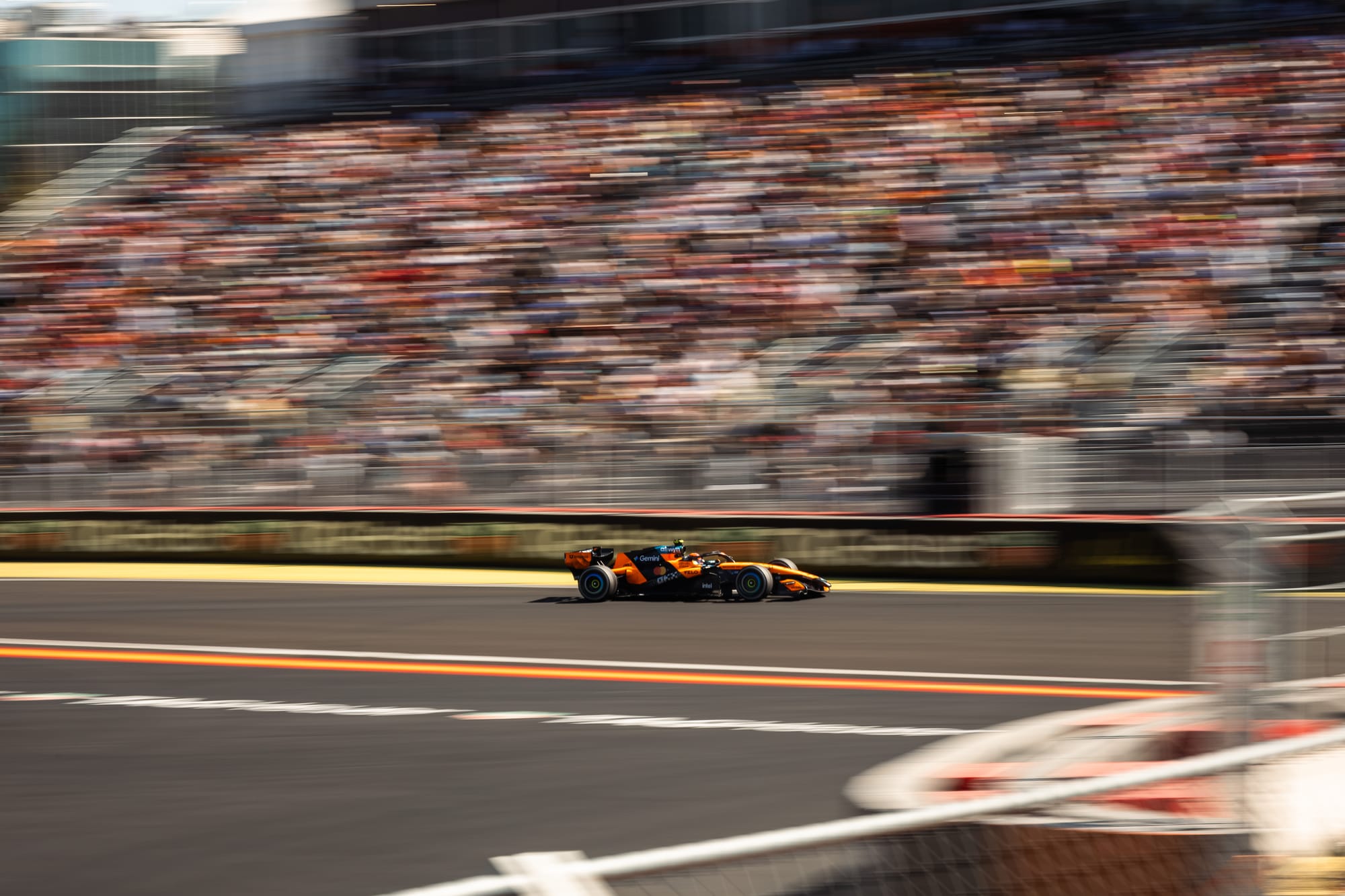
There is little doubt, even from eventual winner Kimi Antonelli, that without the "insanely unlucky" timing of the virtual safety car, Lando Norris would have won the Spanish Grand Prix.
The reigning Formula 1 world champion had built up a comfortable advantage at the head of the Madring field when Lance Stroll’s Aston Martin stopped in the run off at Turn 20 as the leaders were on lap 14 of 57.
Norris was around five seconds past the pitlane entry, and well around the final corner, when race control called for a VSC to allow Stroll’s car to be recovered.
At that point it was too late for Norris to get into the pits for a change of tyres and capitalise on the reduced time loss of doing so while the field was slowed by the VSC. Meanwhile 6.5-seconds further back, Antonelli was perfectly positioned to dive in.
With the VSC remaining out as Norris toured around slowly, committed to going for his stop at the end of the following lap.
But just before he entered Turn 21, the final right hander before the pit entry, the VSC ended. It meant that, in taking his stop, Norris lost the maximum stop time of around 25 seconds – hampered further by a slow tyre change.
That dropped him to fifth behind George Russell. Despite the clear pace advantage he showed early on, Norris’s fate was sealed by two factors: tyre degradation on the hard was negligible and overtaking was nearly impossible unless there was a big tyre offset.
Had passing been on, then McLaren team principal Andrea Stella was in no doubt about what the race outcome would have been.
"I think if overtaking was possible today, we would have had Lando again in the lead because the pace advantage was significant," he said.
In the end, Norris came home third, behind Antonelli (who acknowledged he was lucky) and Max Verstappen.
While the timing of the VSC could not have been crueller in hurting Norris to the max – coming out too late for him to respond and finishing too early for him to benefit – McLaren will still analyse if it could have handled the situation better.
And there are two key questions that it will seek answers to over the coming days.
Should it have pre-empted the VSC?
With the benefit of hindsight, it is obvious to say that the best way for McLaren to have saved Norris’s Spanish GP win would have been to stop the moment the Stroll situation was developing.
While it is true that there was nothing McLaren could have done to react quicker to the VSC being triggered, as Norris was well past the pit entry when it was called, an element it does want to understand better is if there was a way to predict where things were heading.
So when it sits down at Woking to dig through the details, it will want to understand if there was enough information from the state and location of Stroll’s car to pre-empt that the situation was going to switch from a double yellow to VSC imminently.
Stroll’s car, having suffered a brake problem, had come to a halt pointing towards a gap in the barriers – but had not gone all the way through it.
Norris had been warned over the radio shortly before arriving about there being a yellow flag, but there did not seem to be any indication that this would be a serious incident.
Once Stroll had jumped out the car, race control was happy that the marshals were ready to retrieve the Aston Martin and push it through the gap.
It is when track officials are exposed on the other side of the barriers that triggers a double yellow incident being escalated to VSC.
So was this step from a double yellow to a VSC something that McLaren could have predicted?
Based on the positioning of Stroll’s car, probably not.
There was no major damage, no debris scattered everywhere and the AMR26 was only a few metres from safety.
So it is debatable if there was enough information in the less than 20 seconds McLaren had between being aware Stroll had stopped and the chance to make a pitstop call to be convinced that this was going to trigger a caution period.
Had it opted to go for a stop, and then race control managed to deal with Stroll’s car under double yellows, McLaren would have been lambasted for throwing a win away.
As Stella later explained: "If you get it wrong, it would be extremely penalising. From the lead, you pit unnecessarily and now you lost the victory.
"I think a good rule is to respond to what is a fact, to what is the real condition of the circuit.
"But we will definitely take a look as to whether in these conditions it was just simply obvious that it would end up in a virtual safety car. I cannot answer at the moment."
But what was not known to McLaren at the time as well was that race control’s decisions about going for the VSC option was influenced by a desire to clear up debris on the track at Turn 5 as well.
Parts of carbon fibre left on the circuit at the chicane, most likely from the collision between Fernando Alonso and Carlos Sainz on lap 12, posed a clear risk of causing punctures and there was a desire to remove it – which would require a VSC.
So with Stroll’s car in the position it was, the decision to go for the caution was based on the double influence of the Aston Martin and the track debris at the other side of the circuit.
This also explains why there was nearly one minute between Stroll's car being behind the barriers and the VSC ending.
While pre-empting the VSC would obviously have been the right thing to do, there would have been no way for McLaren to know about all the influences race control had in its decisions – especially the Turn 5 debris.
Should McLaren have kept Norris out?
With the VSC out and Norris past the pitlane entry, there was nothing McLaren could do before he came around again.
It made a call to bring him in that lap, obviously in the hope that the VSC continued so the deficit to those who had stopped on the previous lap was equalised.
McLaren thought until the last second that the extended VSC was due to marshals being on the track, but as Norris rolled into Turn 21 the caution period ended.
Norris was 10 seconds from the pitlane entry at this point but the team committed to seeing through on its decision to stop – even though it meant it would lose the full 25s plus what it took for a tyre change.
The subsequent slow stop, which cost more time, ultimately changed little as McLaren thinks Norris would still have returned to the track behind Russell.
The obvious question to be asked here is whether McLaren should have abandoned the stop and pushed on to build up more of a gap – and then changed tyres a few laps later.
The theory is nice based on the pace early on, but the reality was that the tyre situation in the race meant it was never going to prove beneficial.
The hard that many of the cars behind had switched to had proved to be a very robust tyre, with minimal degradation and not needing too much management.
The medium, which Norris was on at this stage, was much more fragile – so after 15 laps of running would not have been in condition for him to get his head down and build up a buffer.
So while things had looked comfortable in terms of the gap to Antonelli prior to the stops, both were coming to the end of their usable tyre life.
As one rival team said about managing the different tyres: "You could drive the medium slowly, or you could go fast and they would be gone after 10 laps."
There is also a small element that, even with the VSC ending, stopping then still has advantages over one in normal racing conditions.
Norris said: "It's the fact that everyone’s kind of on colder tyres and you’re still minimising the pit loss. But the medium tyre was destroyed and the hard tyre was amazing."
As Stella explained after the race, if Norris had stayed out, the upside was minimal.
"We considered staying out," he said. "But you have to accept the fact that now you are on relatively used medium tyres and the people behind you will be on new hards. So you're never going to open a gap on people on a new hard.
"Therefore, we kind of needed to accept that that was what we should have done. It was incredibly unfortunate."
The pace paradox
There was little else that McLaren could have done to change the outcome – as Stella ultimately concluded that his squad suffered from a paradox of being too fast.
Had its race pace not been so good, and Norris not had those six seconds over Antonelli, then he would have been in the perfect spot to dive into the pits when the VSC was called to win the race.
But F1 is not about going slower – and McLaren ultimately knows that it was just a case of wrong place, wrong time.
As Stella reflected on Sunday night: "We take it on the chin that what we could not control just played against us."
from The Race https://ift.tt/W54LPGq


No comments: