
Formula 1 heads to the Azerbaijan Grand Prix for the first race of a punishing triple-header that could prove defining for the world championship.
But it is not an ideal place for teams to unleash the kind of major upgrades they typically would for such a run of back-to-backs.
The layout of the Baku circuit with its long straights puts a premium on aero efficiency over downforce, so the focus is more on optimisation rather than improvement.
That is why teams such as Mercedes and Ferrari are expected to wait a little bit longer before gunning for what will likely be their final development packages of the year.
But there remains plenty of tech intrigue to keep an eye out for this weekend.
New innovation on lighter Williams
After a troubled start to F1's new rules era, Williams hopes that the Azerbaijan GP will mark the start of its recovery.
Having held fire on a major car revamp until now, all eyes will be on the new, lighter chassis that it hopes will mark a step-change in getting rid of the excess weight its drivers have been forced to carry around so far.
What will make the Williams upgrade especially interesting is that team principal James Vowles has talked of there being innovation at the heart of the new chassis when it comes to how it has been manufactured.
"This learning will be one that kicks us off for the next five years," he told The Race recently.
"There's no other chassis in the grid made the way we've done it. I can give you an assurance of that."
Exactly what Williams has done has not been explained in detail yet, but it is understood to revolve around some manufacturing processes that have allowed the team to shed off more mass than would normally be expected.
But a word of caution. Neither Vowles nor the drivers are anticipating a game-changing leap in performance.
As Alex Albon said: "It's going to be a good step, but is it going to be the full step? I'm hopeful for it, but I don't think it would be."
Aston Martin gets lighter too
Aston Martin saved pretty much all its aero upgrades for its mid-season chassis overhaul at the Hungarian GP, as team principal and managing technical partner Adrian Newey slashed weight and addressed the weaknesses of his first AMR26 concept.
With the team wanting to make sure it starts 2027 on the front foot, it does not want to continue development into the end of this season, which is why it has wound down its update rate.
But that does not mean it will not bring new parts - and in Baku it is set to introduce some lighter components to get down closer to the 768kg weight limit.
Chief trackside officer Mike Krack said at the Spanish GP that the changes will likely go under the radar, as teams only have to officially declare to the FIA components that look different.
"We still bring some more parts going forward, some will be declared because we have to, some will not," he said. "I don't think it [Aston Martin's development] is completely finished, but I don't think that we will have an upgrade like Budapest."
Perez gets Ferrari's 'ADUO 2' engine
While the works Ferrari team and one of its customers, Haas, have both used Maranello's latest ADUO 2-spec engine since the Italian GP at Monza in early September, Cadillac has held fire so far.
Due to complications of installing the revised power unit, which requires new parts, Cadillac wanted to wait until after the Monza/Madrid double-header before committing to it.
It has now given the green light for Sergio Perez to run it in Baku, while Valtteri Bottas will have to wait a little bit longer.
The extra power on offer from the engine upgrade will be a welcome boost to Cadillac, which will also be introducing some small aerodynamic upgrades as well.
ADUO 2 will likely be a topic of interest at Ferrari as well, as the manufacturer weighs up its power unit plans over the remainder of the season.
Charles Leclerc's ADUO 2 engine, which was in use when he crashed in the Italian GP, is likely to return to the track for evaluation in Azerbaijan, but it is also possible that he may get a totally fresh one as well to see him through to the end of the campaign.
Baku's long straights mean that it is a good place to take a grid drop for an engine swap.
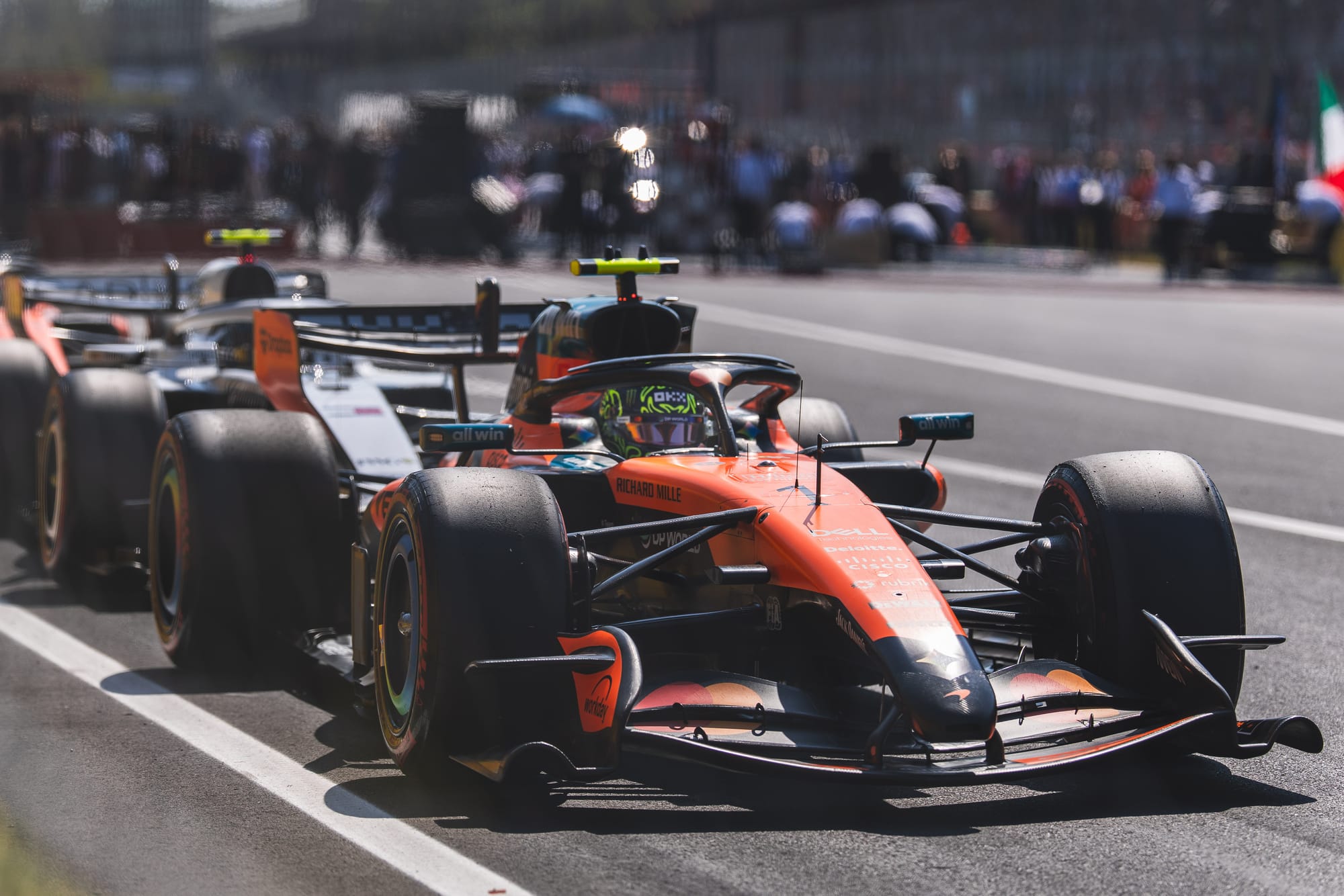
McLaren's H-wing returns alongside another update
McLaren has unlocked a rich seam of performance from its MCL40 since the summer break, having made big gains in fast- and medium-speed corners.
The team is still mindful of some core weaknesses, though, especially when it comes to straightline performance and low-speed turns.
For Baku, which features that very long start/finish straight, McLaren will bring back into action its low-drag 'H-wing' that it raced for the first time at the Italian GP.
It is also set to evaluate another upgrade package that it hopes can deliver gains in areas where it is giving away laptime to its main rivals.
Chief technical officer Rob Marshall said that rules stability meant there was little reason not to keep the upgrades coming.
"With regulatory continuity into next season and the competition at the front so close, our motivation to keep developing the car remains high," he said.
Energy deployment questions
The Baku layout is a mixed blessing for the current energy starved cars.
The tight, low-speed corners and city section that make up the sequence from Turn 1 through to Turn 16 should offer plenty of opportunity to charge the battery and unleash added electrical power.
But the extremely long run from Turn 16 all the way through to the first corner is one where battery efficiency and state of charge are going to be critical.
One thing that teams will need to evaluate is whether the reduced downforce of the 2026 cars means that the fast Turn 18/19 sequence can still be taken flat.
If it can, then that will mean a different deployment pattern compared to if it requires a lift, which will deliver a bit of a boost for energy harvesting.
One other issue, which could cause some trouble over the weekend, is of potential big speed differentials between cars on outlaps and cars on push laps in practice and qualifying.
Teams will want to programme their MGU-Ks to not burn up any battery until as late as possible before the timing line in qualifying, which will mean running slower on the internal combustion engine beforehand down the main straight.
That means a speed profile very different from cars that will have maximised energy usage coming out of Turn 16, and that will be approaching the start/finish line much quicker as a result.
Bigger tyre and brake headaches
It has been well understood that the increased need to harvest energy on the entry to corners this year has resulted in teams calling upon the mechanical brake components much less.
This has had consequences in terms of both brake discs and tyres being much cooler than before, which can be a problem when they are suddenly required.
Baku's long main straight has always meant drivers have had a challenge keeping temperature in the front brakes and tyres as they are cooled down for a long time after the final corner.
The situation could be a bit more extreme this year with the shift of emphasis with the 2026 rules meaning neither are anything like as warm as they were in the past.
McLaren's Marshall thinks drivers could regularly arrive at Turn 1 with things "relatively cold", which could be a recipe for plenty of lock-ups.
from The Race https://ift.tt/ricH5EU


No comments: