
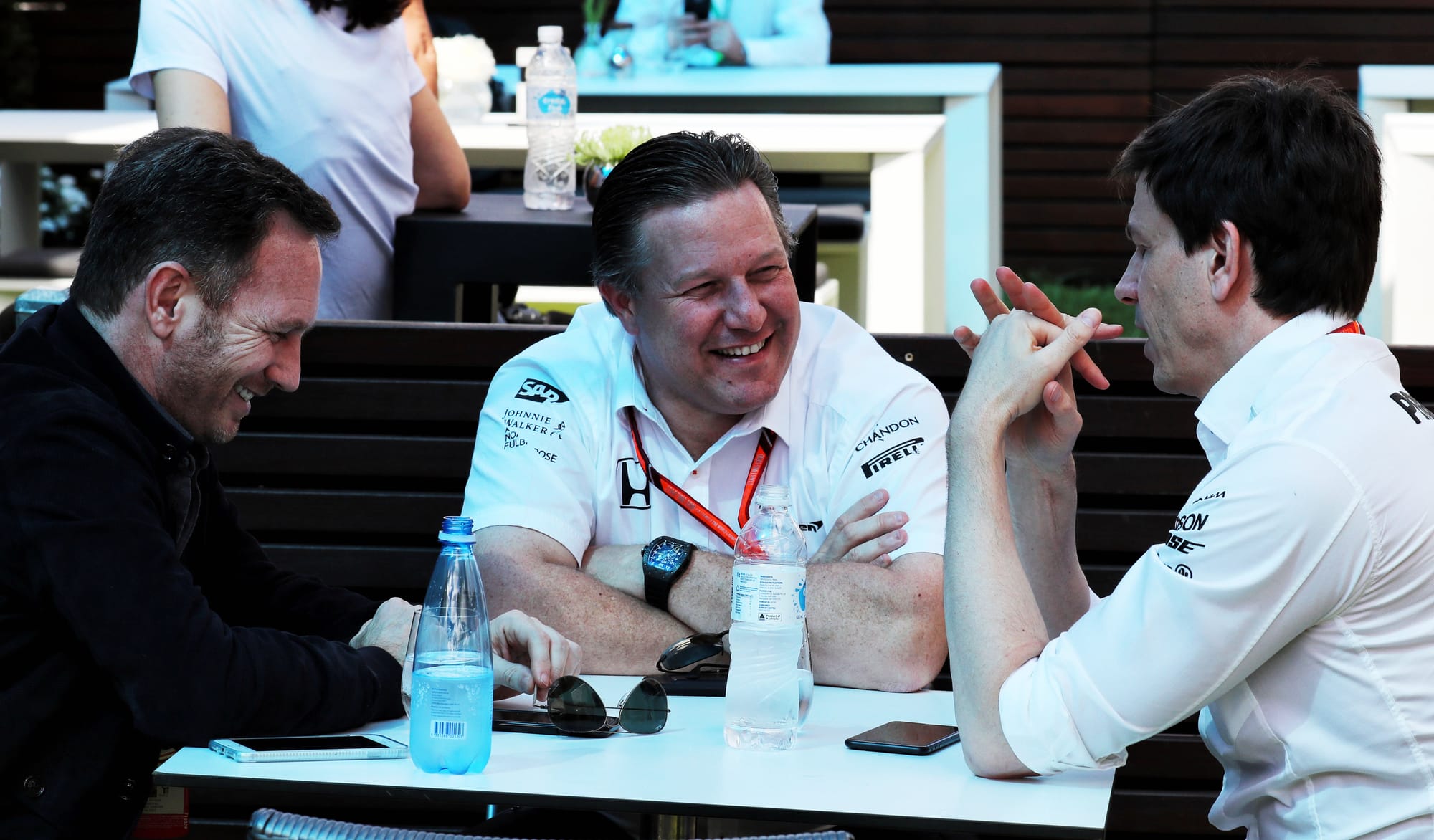
Christian Horner, Zak Brown and Toto Wolff have been three of the most influential team bosses during Formula 1's extraordinary growth over the past decade.
All three have been very well rewarded for it. But the latest set of F1 team accounts filed in the UK reveal something more interesting than simply how much each has made.
They show three very different ways of sharing in the value that has been created as F1 teams have gone from businesses that often needed wealthy owners to keep funding them to scarce sporting assets now worth billions.
Horner was ultimately a very highly paid employee at Red Bull. Brown has participated in McLaren's growth through a long-term incentive scheme. Wolff owns a significant part of the Mercedes team he runs.
The difference between the three helps explain why ownership now appears to be so important to Horner as he considers what he does next.
Horner's departure from Red Bull came with an extraordinary payday.
Red Bull Technology's 2025 accounts disclose £66.988million in compensation for loss of office for its highest-paid director, understood to be Horner, alongside £9.029m in remuneration.
That puts his disclosed package for the year at around £76m.
Some reports have put the compensation above £100m by adding a separate £33.494m figure contained in Red Bull Racing's accounts. But Red Bull Technology explicitly states that its £66.988m disclosure is for the group, which includes Red Bull Racing. The £33.494m should therefore not be added again.
Even £76m is an extraordinary sum.
But perhaps the most interesting thing about Horner's 20 years at Red Bull isn't what he made. It's what he didn't have: ownership.
That should not be confused with Horner having made a bad deal when he joined Red Bull. Quite the opposite.
At the end of 2004 he was 31, had built a successful Formula 3000 team in Arden, and was trying to find a way into F1. He had looked at buying Jordan but simply didn't have the hundreds of millions required to make the step independently.
Then Dietrich Mateschitz bought Jaguar and turned it into Red Bull Racing.
Horner later recalled being summoned to Salzburg and Mateschitz telling him he had big ambitions for the team and was "willing to take a chance" on him. Horner said he was only 31 and "didn't have to think about it for too long".
And the deal itself wasn't bad either. Horner has since recalled that Mateschitz told him he wouldn't be paid a huge salary but would receive a healthy bonus for every point Red Bull scored. Jaguar had managed nine points the previous season. Red Bull scored 34 in its first.
For a 31-year-old team owner trying to find his way into F1, it was an extraordinary opportunity.
Horner helped turn Red Bull Racing from the remains of Jaguar into one of F1's most successful teams, winning six constructors' championships and eight drivers' titles.
But however well he was rewarded, Horner remained an employee of a business owned by somebody else.
Brown's situation at McLaren is different.
McLaren Racing's accounts show its highest-paid director received £81.897m in 2025, comprising £8.215m in remuneration and £73.682m relating to its long-term incentive scheme. Brown has been identified as that director in reporting of the accounts.
The bulk of the package resulted from an incentive scheme connected to the enormous increase in the value of McLaren Racing.
The turnaround has been remarkable. McLaren was in serious financial trouble during the pandemic and brought outside investment into its racing operation. Five years later, the transaction that consolidated the ownership of McLaren Racing valued the business at around £3.5billion.
Brown therefore had a substantial participation in the increase in McLaren Racing's value through his incentive arrangements, allowing him to share in the upside as the business was transformed.
The comparison with Horner is striking. Both received packages of around £80m in 2025, but they got there in completely different ways.
Horner's was dominated by the compensation he received for leaving the business he had spent two decades building. Brown's was dominated by an incentive designed to give him a share of the value created as McLaren Racing grew.
Wolff's position is different again. Mercedes' accounts disclose £9.528m of total directors' remuneration in 2025, although they don't tell us how much of that was Wolff's individually.
His executive pay is, in any case, almost incidental to the important number. Because Wolff owns the asset.
When INEOS bought into Mercedes' F1 operation, the team was divided equally between Mercedes-Benz, INEOS and Wolff's investment vehicle. Wolff therefore had a one-third economic interest in Mercedes F1 while also serving as its team principal and CEO.
That also allows him to participate in the profits distributed by the business. Mercedes paid £125m in dividends in 2025, meaning a one-third shareholder would have an economic interest in roughly £42m of that if the distribution was made pro rata. That money would, of course, flow through the relevant ownership structures rather than simply appearing as part of Wolff's salary.
But last year provided a much bigger indication of what his original investment has become worth.
CrowdStrike founder George Kurtz acquired 15% of Wolff's ownership vehicle. Because that vehicle owned one third of Mercedes F1, Kurtz effectively acquired around 5% of the team.
Mercedes confirmed the structure but did not disclose the price. The transaction was reported as valuing Mercedes F1 at around $6bn, with Wolff receiving approximately $300m for the stake he sold.
And he only sold 15% of his holding.
Wolff retained the remaining 85%, equivalent to approximately 28.3% of Mercedes F1. At the same $6bn valuation, that stake would be worth around $1.7bn.
That isn't $1.7bn sitting in Wolff's bank account. It is the implied value of a shareholding based on the valuation attached to a minority transaction.
But it shows the enormous difference between being paid to create value and owning the value you create.
Horner spent more than two decades building Red Bull Racing and was extremely well rewarded as an employee, including a remarkable payment when that relationship ended.
Brown helped take McLaren Racing from the edge of a financial crisis to a business valued at around £3.5bn, with an incentive structure that allowed him to participate directly in that increase in value.
Wolff did something different. He bought into the business he was running.
As the value of F1 teams has exploded, that has proved to be the ultimate deal.
Which brings us back to Horner.
Since leaving Red Bull, he has become increasingly clear about wanting something different from the next stage of his career.
His language now is particularly interesting when compared with the 31-year-old who described the original Red Bull opportunity as a "no-brainer".
"I've been a hired hand," Horner said recently. "I did 21 years sitting on the pitwall. I don't need to go back to that."
His preference now is to return as "a partner, rather than just a hired hand".
It isn't difficult to understand why.
The original Red Bull deal was a fantastic one for Horner in 2005. What changed over the following 21 years was F1 itself, and particularly the value of its teams.
F1 teams were once sporting operations that routinely consumed their owners' money. Today, the best of them are global sports businesses worth billions.
If Horner is going to spend the next decade helping to build another one, you can see why this time he appears determined to own a piece of it.
from The Race https://ift.tt/7GbeChB
 Reviewed by PAK DERAMA
on
October 16, 2026
Rating:
Reviewed by PAK DERAMA
on
October 16, 2026
Rating:


No comments: