
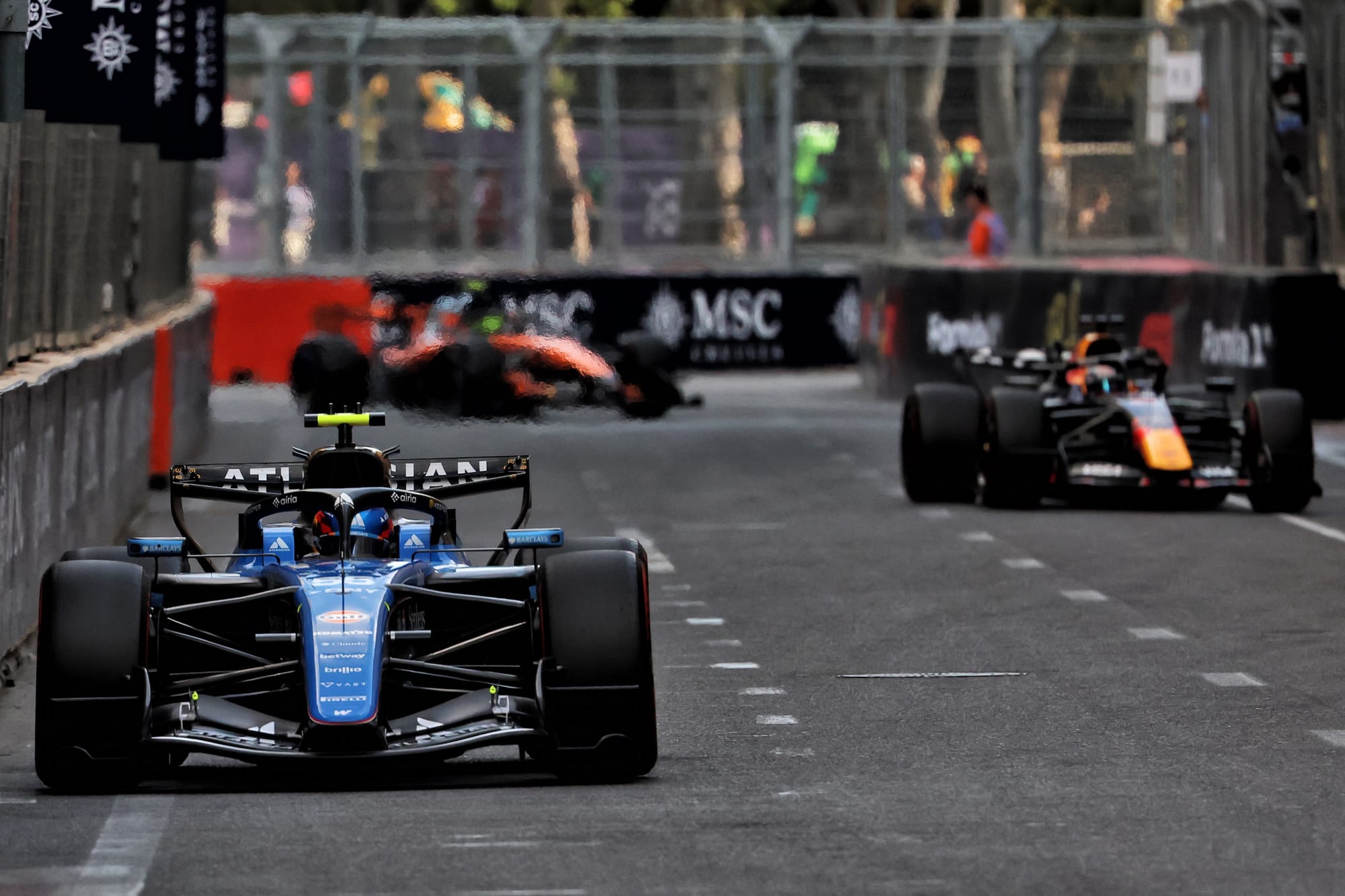
Williams team principal James Vowles cites historical data that suggests Formula 1's big-four teams - Mercedes, Ferrari, Red Bull and McLaren - are becoming even more dominant than ever.
That, he says, has left F1's other teams in a "cost-cap trap" and has prompted him to propose a catch-up system for implementation ideally for 2027.
He claims that across the 10 seasons before F1's cost cap came in from 2011-20, the big four scored 77% of the points available. And in the five seasons since the cost cap was introduced, they have scored 83% of what was on offer.
And Vowles doubled down on that on Friday at the Singapore Grand Prix, saying: "The field isn't compressing - you don't have to use my stats, you can go and look it all up.
"There are less points scored now by the bottom either five or six teams, depending on how you count it, [and] the top four is scoring more in cost cap than they were before. It already tells you it's the other way round, you don't need me to tell you it's there.
"Another stat is there's been one win that hasn't been a top-four team in the last 130 grands prix. Previously, [we] used to have someone who's not a top-four team on the podium...so before cost cap, [that happened] 10% of the time, now it's 5% of the time.
"It doesn't matter what stat you choose, go choose it; you will find we have made it worse."
So, we did look it all up, to make sure the stats stack up.
This citation is based on Mercedes, McLaren, Red Bull and Ferrari, regardless of where they actually finish in the championship.
McLaren failed to finish in the top four seven times across 2013 to 2022, with Ferrari missing in 2020 and Mercedes dropping out in 2012.
Our numbers back Vowles up: the big four teams scored 83.5% across the five completed cost cap seasons from 2021 to 2025.
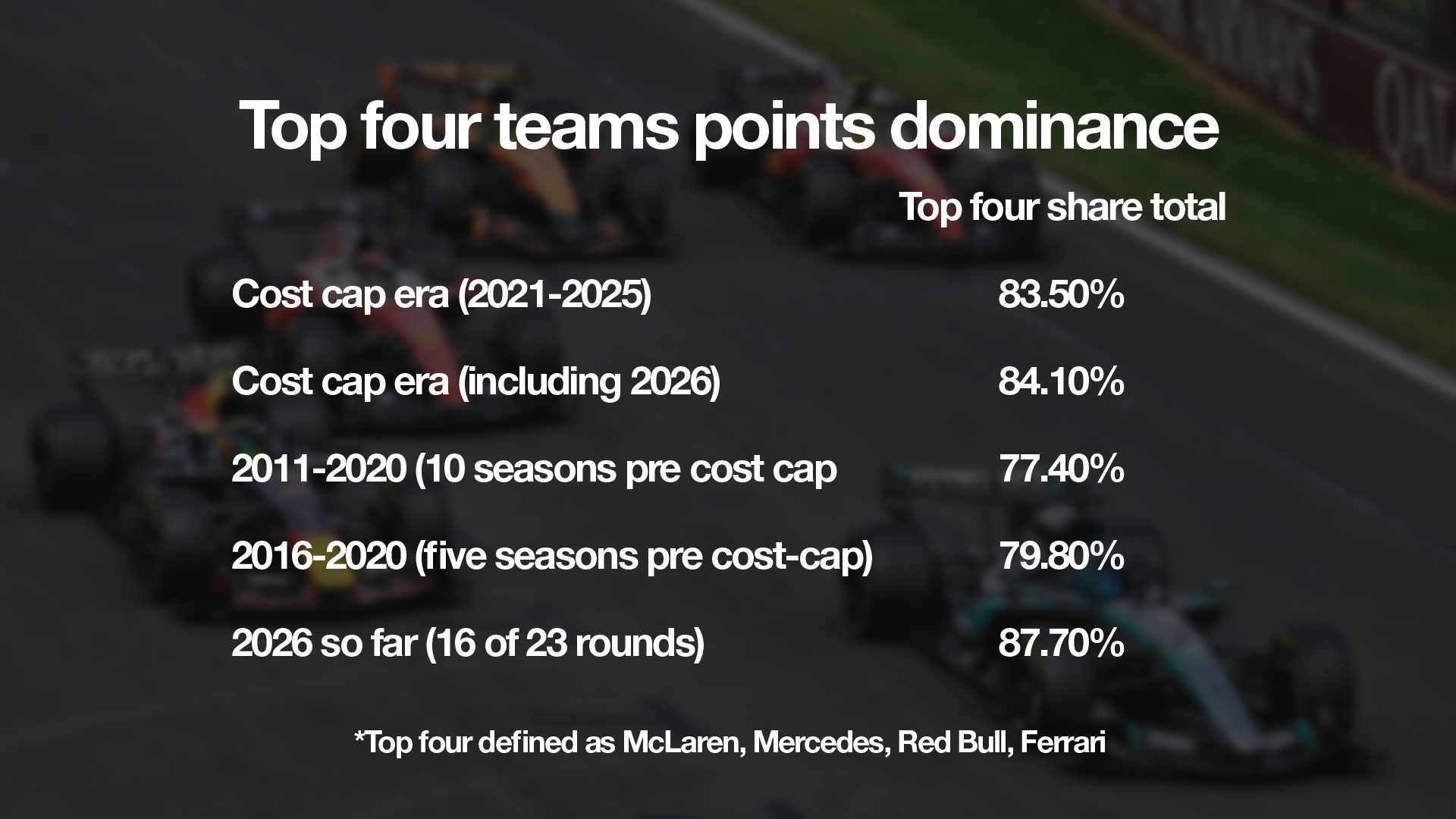
This nudges up to 84.1% once you include the ongoing 2026 campaign, in which the big four teams have scored 87.7% of the points.
It should be noted that McLaren's serial underperformance in the 2010s is a factor, which drags down the average. And its re-emergence as a frontrunning force in recent years has led to that group's points share increasing again.
Therefore, it's a less compelling case for the big four pulling further away.
However, it does show that the hoped for catch-up effect with the cost cap is not happening, and that is a more robust claim to make.
We can also look exclusively at the top four teams in the championship classification.
The percentage of the points scored by the top four teams is remarkably consistent, and generally only leaving around 17% of the points up for grabs among the others.
It's also important to note that this top-four clique is difficult to get into now.
There have been occasional interlopers in this group - most recently Alpine in 2022, which also broke into it as Renault in 2018 and as Lotus in 2012 and 2013, while the team now known as Aston Martin (under both the Force India and Racing Point name) and Williams have also got involved.
But they never became consistent threats for victories over multiple seasons.
And in the past 10 seasons, including this year, only four slots of the available 40 in the top four have fallen outside of the big four teams Vowles identifies. The last time one of the non-big-four teams was in the top three was Williams, which finished third in 2015 (and the previous year as well).
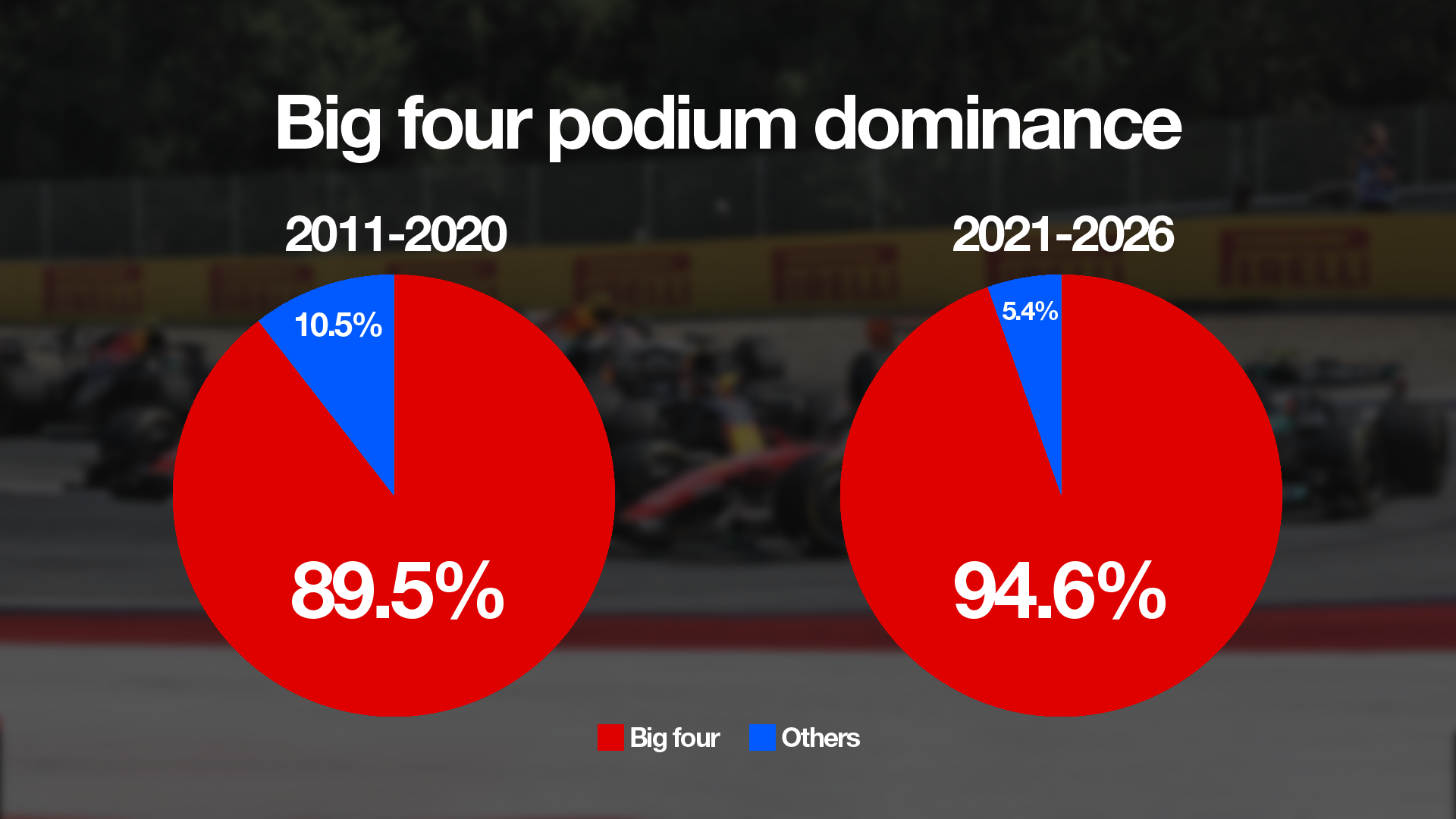
Vowles also offered another measure. In the 10 years before the cap, teams outside of the big four scored 10% of podiums - 62 from 588 races.
Since the cap came in, they have notched up just 5% of the podiums, or 17 of 342.
This is also accurate within rounding errors: the number of podium finishes taken by non-big-four teams is 10.5% in the 10 years prior to the cost cap, and has dropped to 5.4% since.
from The Race https://ift.tt/bKAeFVf


No comments: