
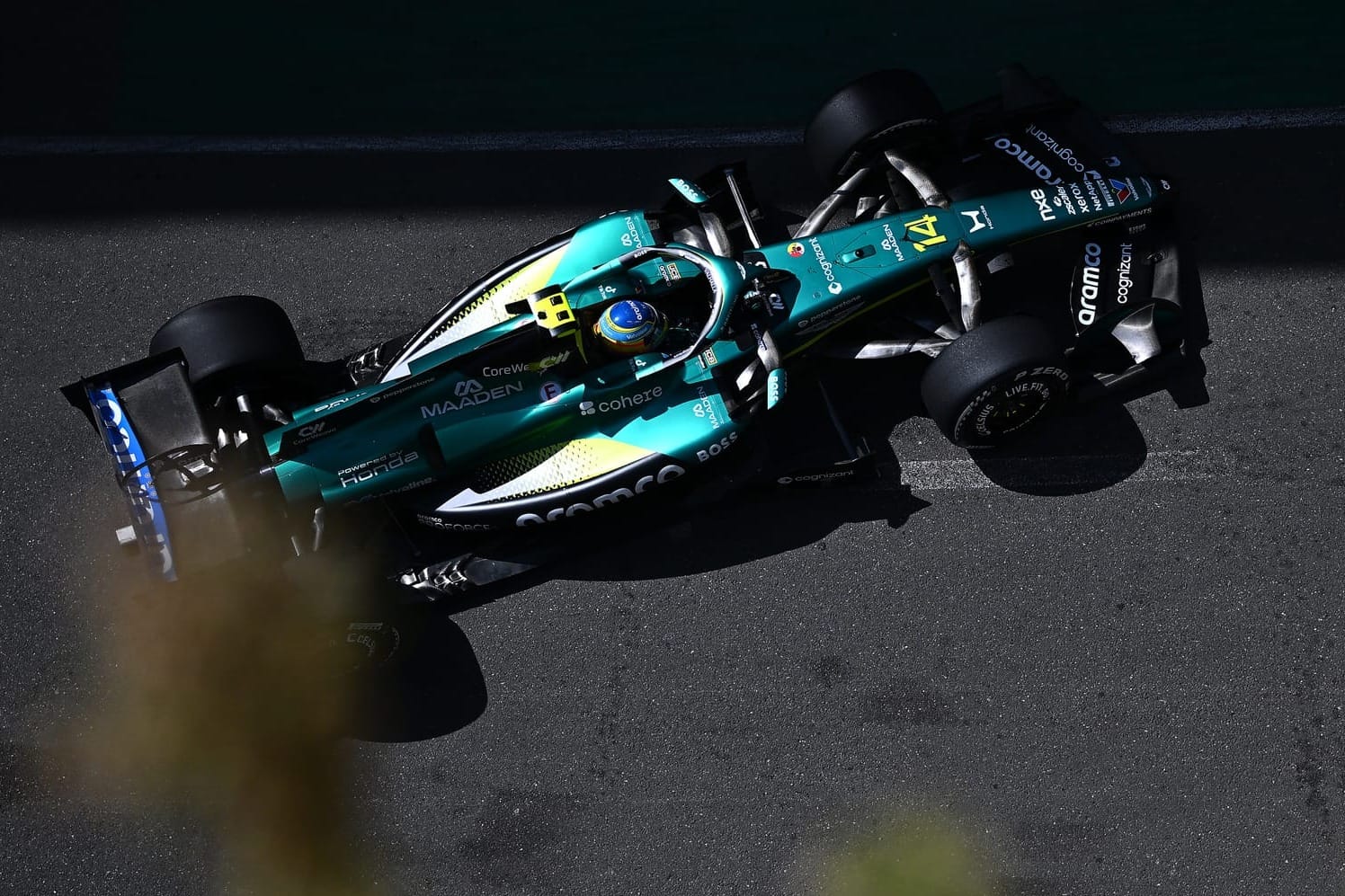
While Aston Martin-Honda's recent form has yo-yo'd, mimicking the style of racing we've come to expect in Formula 1 in 2026, there's been some even stranger things going on with its star driver Fernando Alonso.
I'm not talking about his protracted contract negotiations with the team, recently concluded of course, but more some of the strange technical problems and retirements he's had with what, to be fair, has been the most troublesome car on the grid this season.
In Baku, Alonso got his hands on the secret ADUO 2 turbocharger upgrade Honda fitted first to Lance Stroll's car in Madrid.
Honda's been trying to improve driveability and turbo lag since it brought its mid-season ADUO 1 engine upgrade to Zandvoort, and Honda knew Baku would be an important test for those characteristics.
Mark Hughes: The extraordinary figures hinting at Aston Martin's pole potential
Reduced turbo lag not only improves the overall driveability of the engine, it also helps prevent the MGU-K filling in the engine torque demand gaps created by that lag, whereby the motor essentially replaces missing internal combustion torque delivery with electrical power from the battery.
Lots of short, slow turns with difficult and crucial traction zones are a good test of whether your car and engine are punching off the corners in the right way.
In Azerbaijan, the updated Aston Martin - closer than ever to the weight limit thanks to some lighter components at the rear of the car, plus that spec-2 Honda engine with its (we think) smaller turbo - was working well up to and including the castle section.
But then it was haemorrhaging laptime through sector three, suggesting the MGU-K was doing too much of that 'infilling' early in the lap and then creating energy deployment problems later on.
This is a trend in the car's qualifying performances going back at least as far as the debut of the B-spec car in Hungary, in late July. There is a noticeable degradation in laptime over a single lap, particularly towards the end of that lap, almost regardless of the circuit.
This was even the case in Malaysia - easily that car's best performance of the season - where the rough track surface and overheating tyres robbed all the cars of grip and artificially extended the length and duration of the slow corners and off-throttle moments where the Aston Martin is relatively more competitive.
Returning to Baku, there Alonso retired from the Azerbaijan Grand Prix after 20 laps, apparently with an engine problem.
"I didn't see any alarm," he said afterwards. "But I started losing a lot on the straight. You know, like 1.5 seconds, so something wrong."
But after the race, Honda checked the engine and could find nothing wrong.
"At the moment the engine is OK, we don't find any issue on the data," said Honda chief trackside engineer Shintaro Orihara after that race.
"So we need to check carefully on the engine power and also energy management and also maybe GPS trace."
The Race then asked Honda at the next event in Sepang whether analysis at the factory had revealed any issue, but again Honda said it found nothing amiss.
"We did maintenance and we checked the engine physically," said Orihara. "But still on the data there is no indication of the engine problem."
Something similar happened in Singapore. After yet another Q1 exit, Alonso claimed his car's turbocharger was "broken". The team thus elected to start him from the pitlane with fresh components, but once again Honda could find no evidence of a turbo problem on the engine, beyond Alonso's diagnosis.
Honda's get out of jail card here has been to describe the driver - in this case Alonso - as "the best sensor" inside the car, especially so when that sensor has Alonso's incredible level of feel and experience.
It's also true that drivers sometimes detect problems that aren't initially picked up by engineers - there's a good example given by former Williams technical director Patrick Head, who back in 2005 said its new signing Nick Heidfeld had detected problems with the BMW engine's management system that the team had been "carrying for two years without anyone pointing it out".
That was more than 20 years ago, and the fidelity of data capture in F1 has improved vastly in that time, but it's a good example of how Heidfeld's particular sensitivity as a driver uncovered something problematic that Juan Pablo Montoya or Ralf Schumacher - both objectively more successful F1 drivers then Heidfeld was - either never felt themselves, or were not so unduly affected by to feel the need to raise in debriefs.
Alonso has an incredible reputation for being an accurate engineering reference inside the cockpit, and so if he's detecting an issue you would ordinarily expect whatever Alonso has felt going wrong to show up in Honda's data eventually.
That has't happened (yet) in Alonso's case, and his furious team radio while battling the usually slower Cadillac of Valtteri Bottas in Azerbaijan gave a clear indication he was less than happy with his Honda engine's overall performance that weekend.
Aston Martin trackside chief (and former team principal) Mike Krack later suggested perhaps the tow effect from following the Cadillac, combined with having the extra boost available from overtake mode being active, might have caused Alonso to feel as though there was a problem with his Honda engine.
That could also be possible - that Alonso has felt a problem that doesn't actually present itself in reality.
Perhaps no one will ever know for sure but, until Honda finds something it's yet to spot in its telemetry, all the signs point to Alonso basically throwing in the towel and taking an early bath in Baku.
And, given the team's woeful overall performance in 2026, maybe no one could blame him!
from The Race https://ift.tt/Vy9TEGl


No comments: