
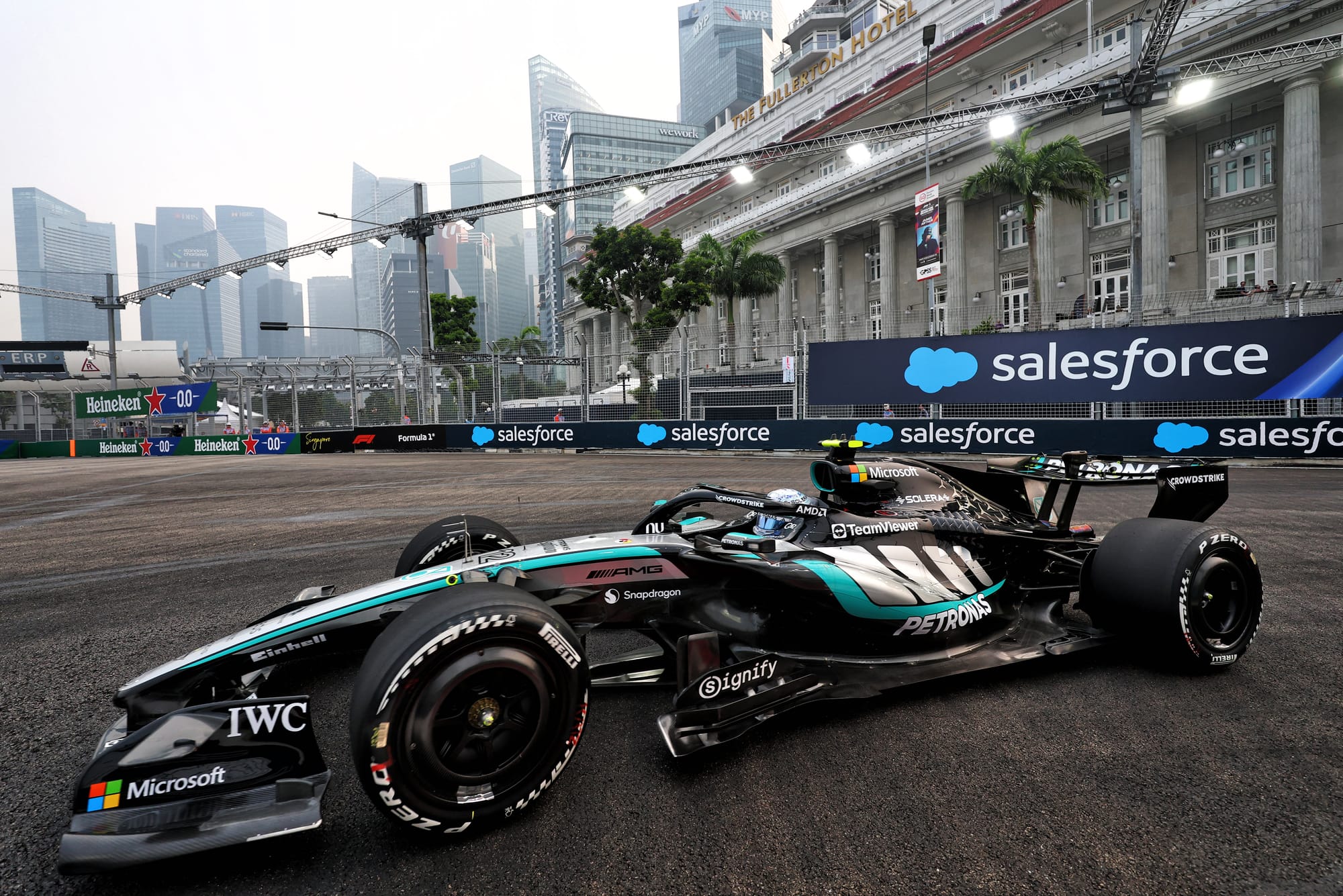
Is this year's dominant force, Mercedes, about to limp across the finishing line after admitting that Red Bull has become the Formula 1 team to beat?
With all new regulations this year, the development war at the front has been hugely influential on a volatile competitive order. And upgrades are supposed to do what they say on the tin: be new parts that improve laptime and overall performance.
Mercedes had high hopes for the significant package it brought in the middle of F1's recent triple-header. After narrowly beating Red Bull's Max Verstappen in the Azerbaijan Grand Prix, George Russell said "we're hoping to make a bigger step to the rest of the field" at the next race in Malaysia, where Mercedes' aerodynamics overhaul would debut.
Instead, this appeared to bring a step backwards in pace and a much narrower operating window, and even inspired Russell to 'downgrade' his car and run on the older specification in a bid to help solve the team's confusion by letting it compare the upgrade on Kimi Antonelli's car.
In this time, Verstappen won the Malaysia race and both the sprint and grand prix in Singapore, while Ferrari was also quicker than Mercedes in both those events.
And even after a second weekend running the upgraded package on runaway championship leader Antonelli's car, Mercedes admitted it has not yet brought the level of performance it thought it would offer.
That has to sound alarm bells about the end of this season, and the start of next, with some uncomfortable parallels to be drawn with Mercedes' development difficulties over the previous four years.
It also means there's a lot more riding on the next race in the United States, where Antonelli has his first chance to wrap up the drivers' championship, and where Mercedes will get a much clearer read on how well it understands and can actually optimise its upgraded car.
Mercedes' upgrade introspection
Look at the headline results, and the triple-header was pretty good: Russell won in Baku, while Antonelli was second in Malaysia then third in Singapore.
But there's been an undeniable shift across those weekends.
Red Bull has made a clear step with its 2026 car thanks to not just a Baku chassis upgrade but also the progress it has made with its first-ever F1 engine. That's despite it being the only manufacturer without additional development opportunities after being unexpectedly ranked the best internal combustion engine by the FIA's ADUO assessment process.
That progress is what led Russell to declare that Red Bull is now the team to beat, while Mercedes team principal and CEO Toto Wolff has been lavish with his praise as well.
"You can't see that it's lagging," said Wolff, when asked about Red Bull's first in-house engine. "They have done it very well."
It's Mercedes' own introspection about the puzzling introduction of its upgrade that is more significant, though, and what we're really interested in.
The key detail is that Mercedes was optimistic that only its second major package of the season would deliver a three tenths of a second gain. What transpired instead was actually a step back in performance.
This was put down to the Sepang track surface being unusually rough compared to most circuits, and how it generated disturbed airflow that affected the car's performance.
But on Friday in Singapore, where only Antonelli continued with the upgrade, his car simply did not look good: it had too much rear instability, which inspired a lack of confidence under braking and caused sliding on the way out of corners, while it was also overheating its tyres.
A double-swoop solution helped Mercedes dig itself out of trouble.
The first of those only came during the Saturday sprint race, where Antonelli was encouraged to change his diff setting on the entry to and in the middle of corners, in response to a lap-11 complaint that "I have so much oversteer".
That brought the car alive as Antonelli was far more comfortable and closed back in on the McLarens before they wiped each other out.
Then, before qualifying, Mercedes got his car into a better window by raising its ride height and shifting its aero balance backwards. This sacrificed some peak theoretical performance but made the balance more benign, and Antonelli drove a solid race to third - with Mercedes particularly encouraged by his pace in the final stint.
While Wolff accepted the upgrade still wasn't as quick in Singapore as it should have been, the process of finding a more workable sweet spot for the car in-weekend gave Mercedes hope.
"Does it have the performance that we were hoping the upgrade would bring? I don't think so yet, but it was a step in the right direction," said Wolff.
It's important to qualify this by pointing out that a track such as Singapore, with mostly slow corners, is easier to balance up within the changeable mechanical and aero set-up parameters because there isn't the kind of trade-off that Austin's Circuit of the Americas will demand with a big mix of corner types.
In short, don't take Singapore as a given that this was a breakthrough in understanding. Especially as the way the upgraded Mercedes works could be fundamentally trickier.
Wolff referenced the car requiring a "very different set-up philosophy", and the balance window is narrower. That means it transitions quickly between understeer and oversteer, a characteristic that also results in the tyres sliding more.
The fact Mercedes worked so hard to get Russell out in qualifying despite an engine-change grid penalty shows just how desperate the team was for comparative data between its old and new specifications.
How this compares to Mercedes' previous dominance
But if Mercedes has indeed moved in the right direction with what it gleaned in Singapore, will it be right at the front again with both upgraded cars at their best in Austin? This is the key, and most intriguing, question - not just for the end of this season but the run into 2027.
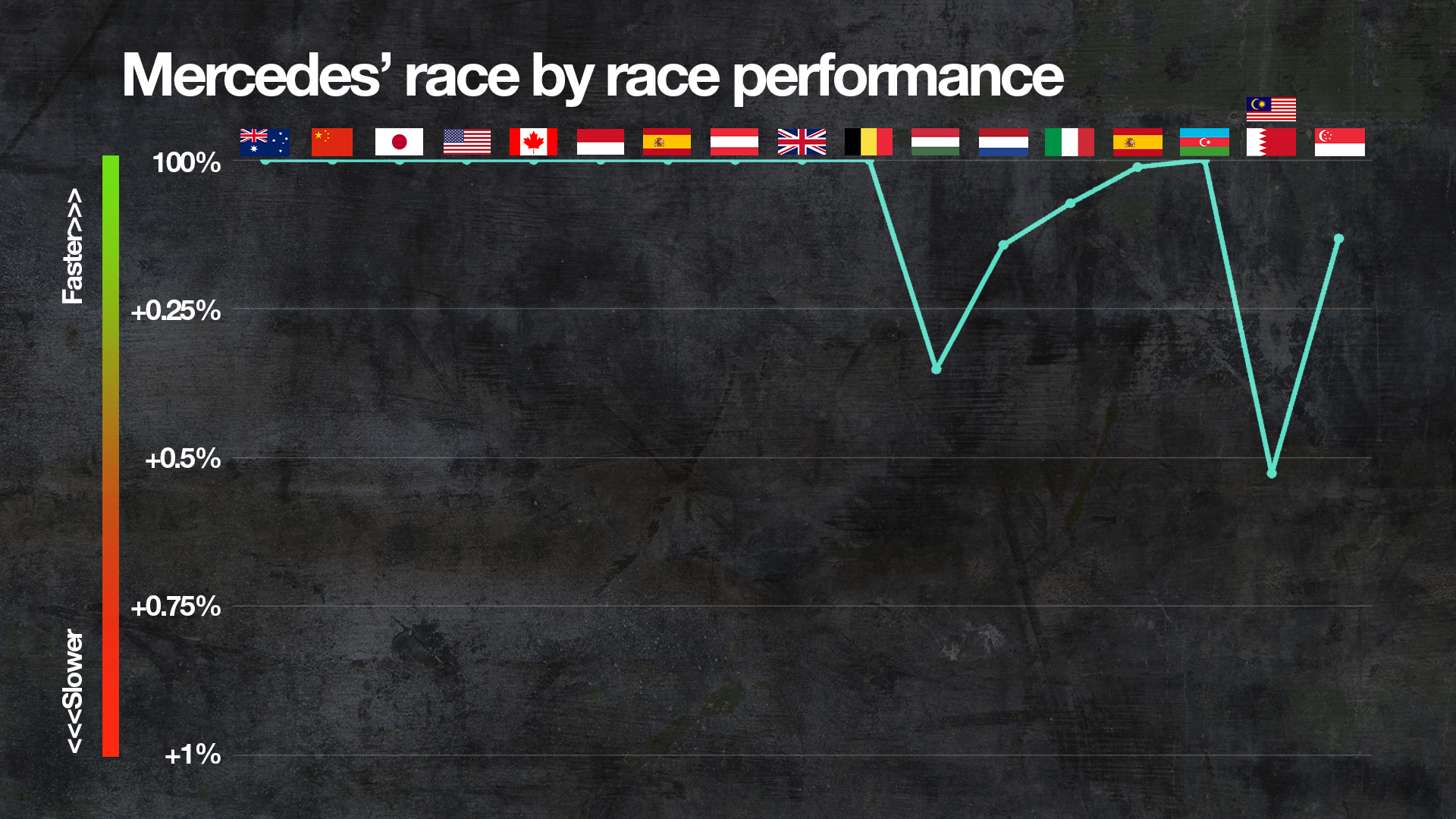
Its advantage has definitively been eroded since the start of the year. Having taken the first 10 pole positions, it's recorded just one in the seven races since. That was Russell's emphatic 0.837s advantage in Baku, a track that played perfectly into Mercedes' car and engine strengths.
Antonelli had also won the two preceding races: at Monza, where the W17 was again the fastest, and in Madrid, where a poorly timed virtual safety car was likely all that stood between McLaren's Lando Norris and victory.
So how exactly does Mercedes compare, and is the Red Bull package really the fastest now?
Mercedes was actually quickest on average across the triple-header, but that's skewed by Russell's huge margin in Azerbaijan - the biggest pole gap of the season.
Without that, it's been third-best behind Red Bull and Ferrari, and probably fortunate its upgrade confusion has coincided with McLaren's own slump.
So there's definitely an interesting contrast in how Mercedes' season looks overall, on paper, and the momentum within it. And it's different to Mercedes' previous era of domination, too, which means there's absolutely no guarantee its broader 2026 stranglehold continues into next year.
From 2014 through to 2020, Mercedes had the drivers' and constructors' championships sewn up early each time it did the double. Its 2014, 2015 and 2016 campaigns are statistically still the most-dominant campaigns in F1 history by total number of points scored.
Sometimes it had stronger external opposition mid-season than others, but it typically stayed on or ahead of the curve - and if it did come under more pressure that could sometimes be explained by switching focus to the following year nice and early, not suffering development missteps deep into the season.
This time, all three of Mercedes' rivals are a lot closer than other teams were in its last run of title sweeps. So even if the early-season trend looked familiar there's just nothing like the same margin for Mercedes.
Why Austin is so important
To underscore how competitive this lead pack is, at both the Spanish and Azerbaijan GPs the top four in qualifying were all from different teams.
Now Red Bull's hitting its stride, Ferrari's proved it still has Mercedes-beating pace at its best, and even though McLaren has been in a rut it was scoring poles and winning races just one month ago and still has multiple upgrades to come.
That's why it's so important Mercedes responds to the pressure, starting at Austin - which could be where it finally introduces the engine upgrade it's been afforded under ADUO.
If it does, this is likely to be on Antonelli's car only as Russell's only just taken a fresh set of components and would need yet another grid penalty.
Reinforcing its status as the best overall power unit would certainly help Mercedes' cause but as important, if not more, is how the recent chassis upgrade performs through the fast sweeps.
Mercedes has absolute belief that the upgrade has improved the car in high-speed and medium-speed corners. So its performance in the first sector in particular will be worth keeping an eye on, as will its speed down the back straight - as the upgrade came at a cost of low-speed corner performance and straightline speed in Malaysia (although this looked better in Singapore).
This is so important at Austin because the upgrade is supposed to set the course for Mercedes' development route through 2027.
"In Austin we shall see whether we can continue to consolidate that and whether in effect, it has more performance because it’s crucial for the development direction for next year," said Wolff.
Mercedes needs confidence in its understanding and choices right now, to keep its on-track direction right but also to banish any doubts that might have crept back in from the ground-effect era - a ruleset it never completely grasped.
That's why there's so much more riding on the US GP, and the rest of the triple-header in Mexico and Brazil, than the chance for both championships to be wrapped up early.
It can shore up the path towards another dominant Mercedes spell - or signal that its return to the top could be short-lived.
from The Race https://ift.tt/9n8BhcE


No comments: