
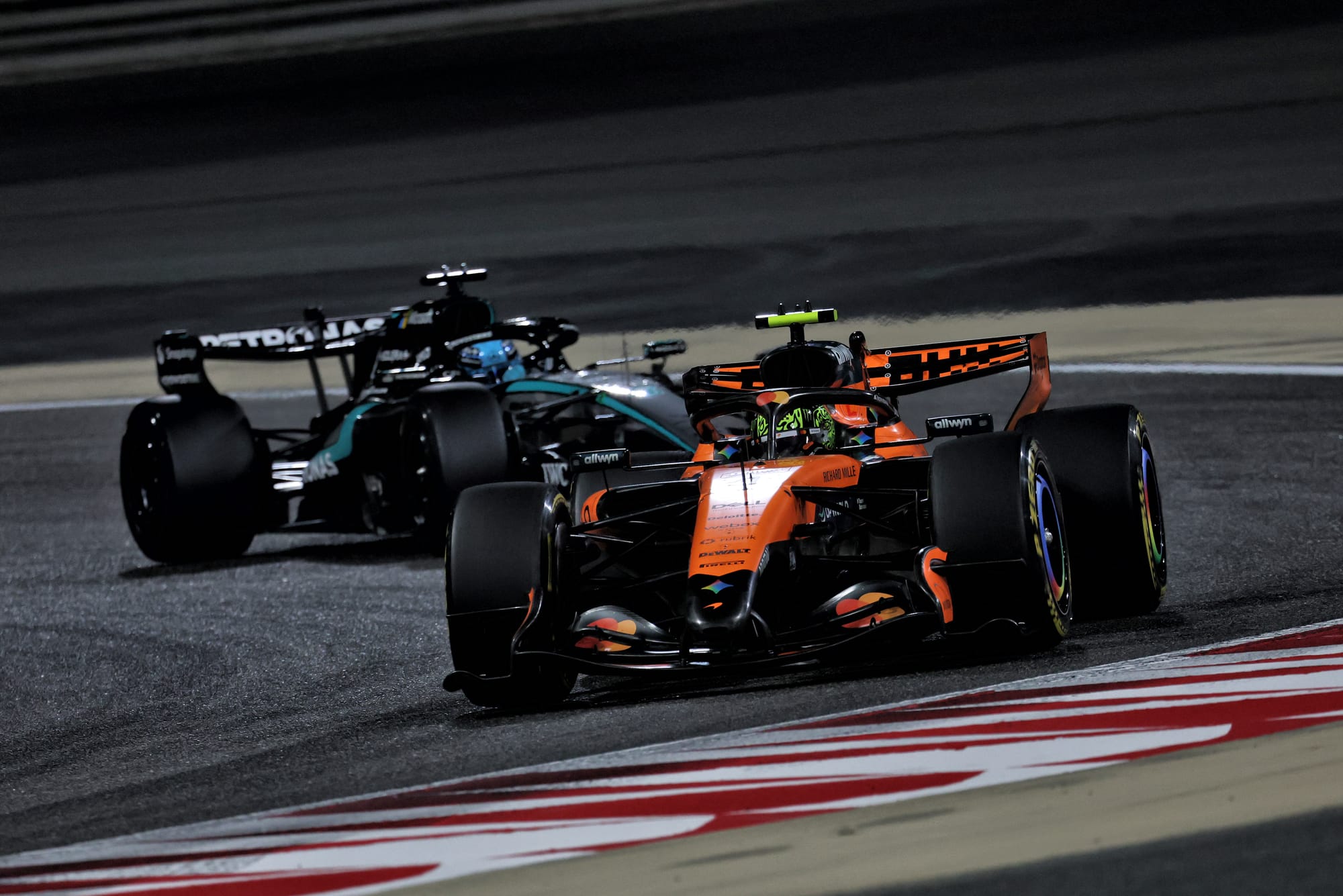
Mercedes customers McLaren, Alpine and Williams can expect a performance step for the Formula 1 season opener in Australia when they get their hands on the latest race-spec power unit for the first time.
With all-new rules coming into play for this season, and Mercedes facing the challenge of supplying four teams in total, it has emerged the German manufacturer ran slightly different specifications of power units during testing.
With the pre-season build-up more about ensuring reliability was robust, especially with teams needing to understand the complexity of energy management, Mercedes opted to give its customers a proven specification so they could get on with their programmes.
And, as part of its bid to lock down the engine version that it will commit to for the start of the season – with homologation set for March 1 – the works Mercedes squad got exclusive use of the latest development version of its M17 E performance.
Only needing to prepare the latest parts for one team, rather than having to think about supplying four outfits, will have been a big help logistically in terms of manufacturing timetables, and made sense to prove out the version.
While the variations between the engine types were unlikely to have been huge, there would have been differences there.
And, with F1’s rules clear that customers must get the same specification as works squads once the season starts, it means that Mercedes’ trio of partners can look forward to a step for Melbourne when they move to the latest version too.
McLaren team boss Andrea Stella did not want to go into the details of any differences between the test versions of power units, but said that the most critical thing was that Mercedes nailed the best specification for Australia.
“I don't want to comment too much in terms of specification of hardware,” he said, when asked by The Race about the situation.
“I think that's part of the strategy that HPP deployed in terms of supplying the hardware, the power units, to the customers and to the works team.
“It's certainly been an intense and pushed programme for power unit manufacturers, not only for the teams from a chassis point of view.
“But what is important is that the right specification is available for race one.
“I have to say that the power unit we had during this test behaved extremely reliably and gave us the opportunity to do all the tests that we wanted to do, and also learn about the interaction between power unit, chassis and driver.”
F1’s rules are strict in ensuring that there is complete parity of performance between a works team and its customers.
Article 1.4 of Appendix 4 of the technical regulations states that: “each power unit manufacturer must submit one homologation dossier which applies to all competitors it intends to supply.
“Only the fuel specification, the engine oil specification and power unit wirings may differ between competitors.”
The rule book also lays down that software settings have to be identical too, to stop customers from not having access to higher performance modes.
The rules add that all power units must be “operated in the same way”, “run with identical software for PU control”, and be “capable of being operated in precisely the same way.”
Regarding petrol, the regulations state that specifications of engine oil and fuel must be “identical specification” to the works team unless an alternative supplier is preferred by the customer.
from The Race https://ift.tt/91gAbdN


No comments: