
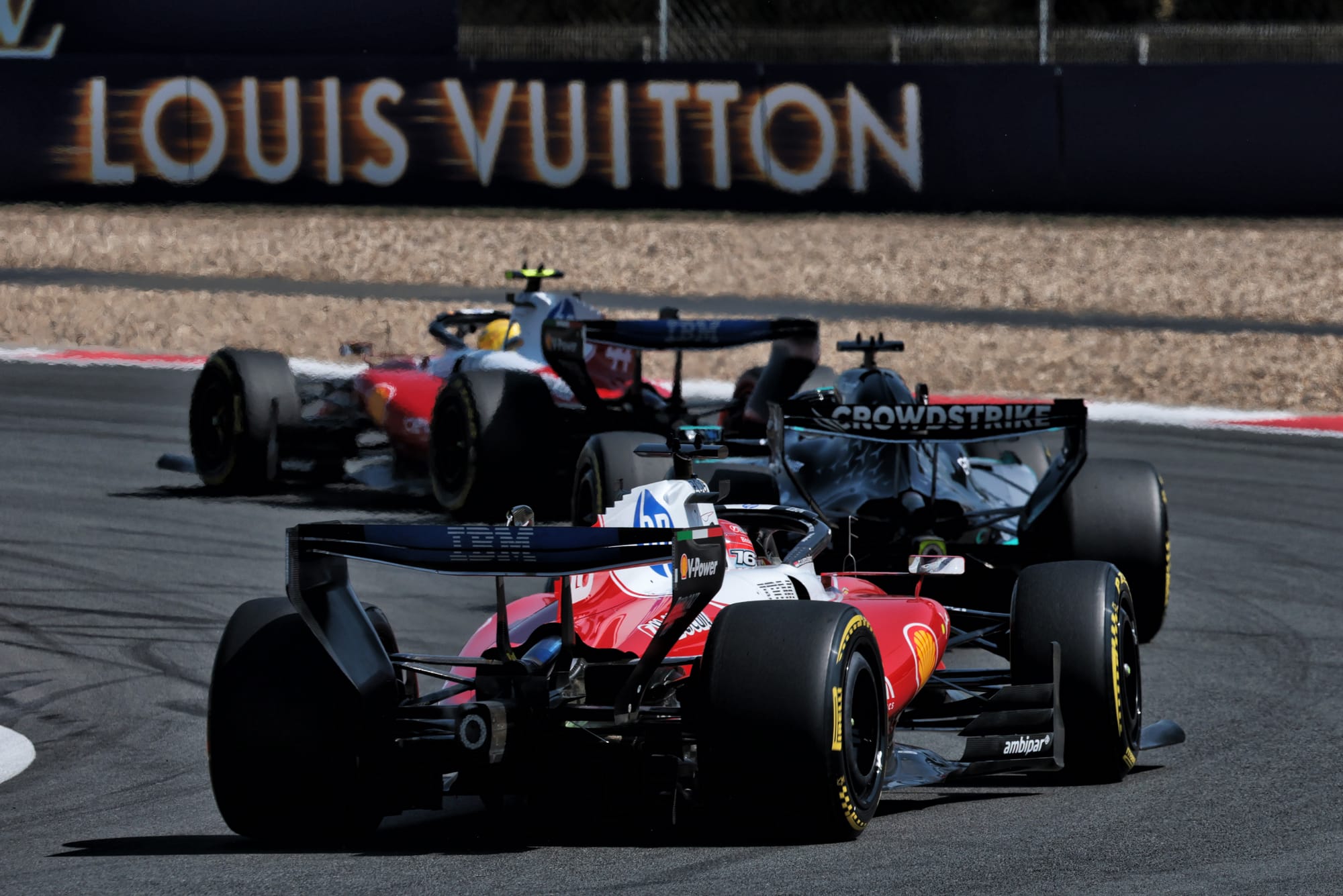
The opening races of the 2026 Formula 1 season have shown that the winter rumours about the advantage of the Mercedes power unit were well-founded.
The works Mercedes team, in particular, has also shown an advantage in the electrical management of the engine, something that its customer teams, McLaren, Alpine and Williams, have not yet fully mastered.
Major manufacturers are holding a predictable advantage in the early phase of these regulations.
In the new regulatory cycle, one of the most delicate elements is not only the pure performance of the power units, but also their strategic management in relation to the Additional Development and Upgrade Opportunities system.
From Australia onwards, the FIA has been measuring the performance of power units through a dedicated index based on how much bhp (or kWh) the internal combustion engine produces - comparing each manufacturer to the current benchmark, which is clearly the Mercedes power unit.
The first checkpoint for evaluation was set to happen after race six in Miami but, with the cancellation of Bahrain and Saudi Arabia, when exactly the new first reset now takes place is under discussion.
The Ferrari-Mercedes battle is largely focused on extracting the maximum possible advantage ahead of that deadline.
Power unit power games?
An engine manufacturer qualifies for additional upgrade opportunities by falling into one of two performance windows: if it is between 2% and 4% off the benchmark, it is allowed to make one upgrade later in the year and another for 2027; if it is 4% off or more, two upgrades later in the year and two in 2027 are permitted.
In practical terms, to fall into this category would mean being 20bhp down.
The FIA is carrying out its measurements using its own tools to calculate this, and has not made public the mechanisms it is using to analyse power unit performance.
Ferrari is known to believe Mercedes is holding back part of its engine's potential in order to keep Ferrari below the 2% threshold and prevent the upgrade system from kicking in. It seems almost certain the other manufacturers - Audi, Red Bull Powertrains and Honda - will receive their development opportunities.
The regulations prevent sandbagging thanks to the FIA's ability to revoke slots at its discretion, and it can also verify values at the factory through simulations on manufacturers' test benches.
In the case of Mercedes, there are also four teams powered by its engine for the FIA to take data from.
But Ferrari represents the most interesting case. At Maranello, Ferrari's factory, work is reportedly underway on a new internal combustion engine specification, a clear sign that current performance is not considered sufficient to compete at the highest level.
Ferrari believes it is highly likely to qualify for upgrades in at least the 2% and 4% range, as the Ferrari power unit is estimated to have a power output of at least 15bhp less than the Mercedes.
It is also possible Mercedes is managing its power unit because there are still some reliability concerns that require a more conservative use of peak power.
In both Australia and China, the W17 demonstrated its superiority by sustaining peak power for longer, reducing the need for super clipping - to help charge the battery while on full throttle - thanks to its more efficient energy recovery.
Qualifying for upgrades would allow Ferrari to work on the new internal combustion engine, an area where Ferrari power unit technical director Enrico Gualtieri's group believes the main shortcomings lie.
Does Ferrari have the best car?
The Ferrari power unit has so far proven to be the second-best on the grid, but the gap to Mercedes in efficiency has emerged despite the SF-26 being, according to some, the best car aerodynamically.
Taking team principal Fred Vasseur's suggestion that Ferrari expects to meet the criteria for an upgrade - and let's say for argument's sake its deficit is at the base 2% level required to qualify - and applying Ferrari's 100.948% 'supertime' relative to Mercedes from the first two rounds of the season, that would suggest its chassis is around 1% better than the Mercedes.
It is well-established at Maranello that Mercedes, under normal conditions, will be faster on most tracks throughout 2026, effectively making this season a transitional year for Ferrari. A new engine would therefore be strictly necessary to compete for victory in 2027.
Ferrari will conduct a 200km filming day at Monza next month - in the gap now created by the Bahrain-Saudi Arabia cancellations and prior to round four in Miami in early May - barring unexpected changes. The choice of that circuit is clearly aimed at gathering further data on energy management at the most critical track on the calendar.
Being eligible for upgrades from the outset would allow Ferrari to anticipate certain interventions on the thermal side and evaluate its on-track results in the final quarter of the 2026 season.
For now, it seems unlikely it will fall into the 4%-plus region, which Red Bull Powertrains, Audi, and of course Honda, could instead achieve.
from The Race https://ift.tt/xLoFgCN


No comments: